From rehab to resilience: training with limited mobility
Recovery, frailty and limited mobility are some of the most under-served needs in Malaysia, and some of the most rewarding to train. Safely, and with your doctor.
Written & reviewed by Thurairaj Manoharan, physiotherapist · Updated
Some of the people who benefit most from training are the ones told they can't do it: those recovering from a stroke or surgery, living with limited mobility, or worn down by frailty. With a physiotherapist's guidance and the right adaptations, almost everyone can rebuild capability, and the gains are often life-changing.
Important: exercise after a medical event must be guided and coordinated with your doctor or hospital physiotherapist. We are physiotherapist-led and work alongside your medical team. See our medical disclaimer.
Seated and chair-based training
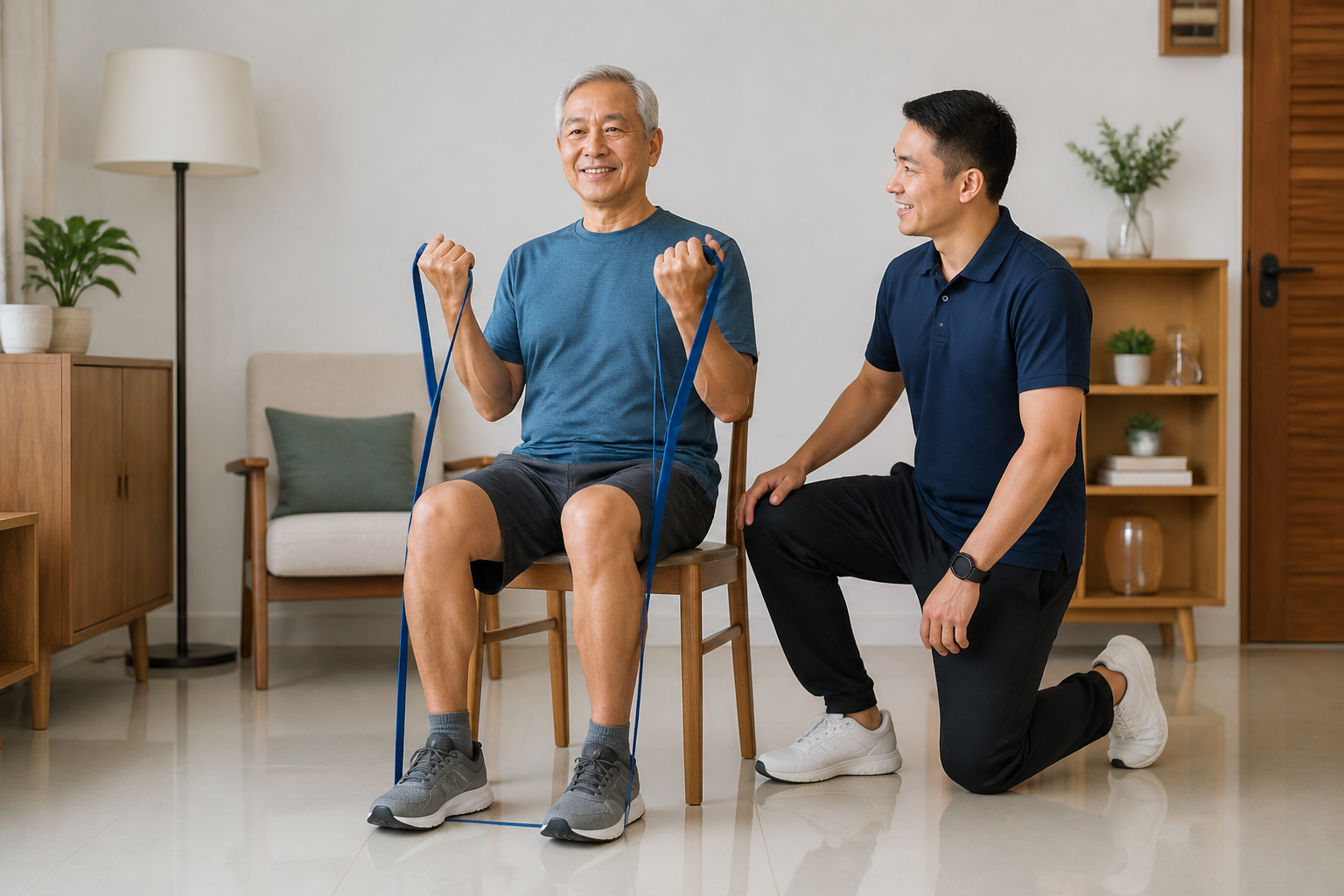
For people who can't stand for long or have limited mobility, seated and chair-based workouts build genuine strength, mobility and cardiovascular fitness. The exercises are adapted, but the principle (progressive, measured loading) is exactly the same.
Recovery after stroke, surgery or a fall
Structured exercise is often central to recovery after a stroke, a joint replacement, a cardiac event or a fall, rebuilding strength, balance and confidence. It must be conservative and coordinated with your medical team, which is exactly how we work.
Rebuilding balance and confidence after a fall is one of the most common reasons families call us. See our programme for ageing parents.
Reversing frailty and deconditioning
Frailty is far more reversible than most people assume. Even very deconditioned older adults rebuild strength and function with gentle, progressive training started from wherever they are today. The key is to start: small, safe and supervised.
Why home visits suit this best
For someone with limited mobility, getting to a gym or clinic is often the hardest part. Training at home removes that barrier entirely, and lets us adapt the work to your real environment: your chair, your stairs, your bathroom. We coordinate with your medical team and coach by home visit across the Klang Valley.
Written & reviewed by
Thurairaj ManoharanPhysiotherapist · 13+ years in healthcare
Paralysed by Guillain-Barré Syndrome as a teenager, Thurairaj rebuilt his body through physiotherapy, lived proof that the right movement, applied consistently, restores function.
Exercise for Cancer Survivors: The Basics of Exercise Oncology
Why exercise is increasingly part of cancer recovery, how it helps with fatigue and strength, and how to train safely during and after treatment.
Read →Returning to Exercise After Surgery or a Joint Replacement
How to rebuild strength and mobility safely after surgery or a knee/hip replacement: progressing from rehab to resilience, with your surgeon's guidance.
Read →Exercising Safely After a Stroke (With Medical Guidance)
How structured exercise supports recovery and rebuilds strength after a stroke: safely, gradually, with your medical team, in the Klang Valley.
Read →Cardiac Rehab: Rebuilding Fitness After a Heart Event
How structured, supervised exercise rebuilds fitness and confidence after a heart attack, surgery or diagnosis, safely, and always with your cardiologist.
Read →Frequently asked questions
Can I exercise with limited mobility or from a chair?
Yes. Seated and chair-based workouts can build real strength, mobility and cardiovascular fitness for people who can't stand for long or have limited mobility. The principles of progressive training still apply. The exercises are simply adapted.
Is it safe to exercise after a stroke or surgery?
Often yes, and it's usually an important part of recovery, but it must be guided and coordinated with your medical team. We work alongside your doctor or hospital physiotherapist, never instead of them, and start conservatively.
Can someone very deconditioned or frail still improve?
Yes. Frailty is one of the most reversible conditions when training is dosed correctly. Even very deconditioned older adults rebuild strength and confidence with gentle, progressive work started from wherever they are.
Rebuild strength and confidence, safely, at home.
Physiotherapist-led, doctor-coordinated home coaching across KL & Selangor.
Start with a free, no-obligation chat on WhatsApp
Home visits across Kuala Lumpur & Selangor (Klang Valley) · in-centre by appointment, Putra Heights