Measure what matters: longevity metrics that count
What gets measured gets managed. Here are the markers worth tracking, and the simple tests you can do at home today.
Written & reviewed by Thurairaj Manoharan, physiotherapist · Updated
Longevity training without measurement is guesswork with good intentions. The point of tracking isn't vanity. It's feedback: knowing whether the plan is working, and where your weak link is. The best metrics are the ones you can act on.
Tests you can do at home
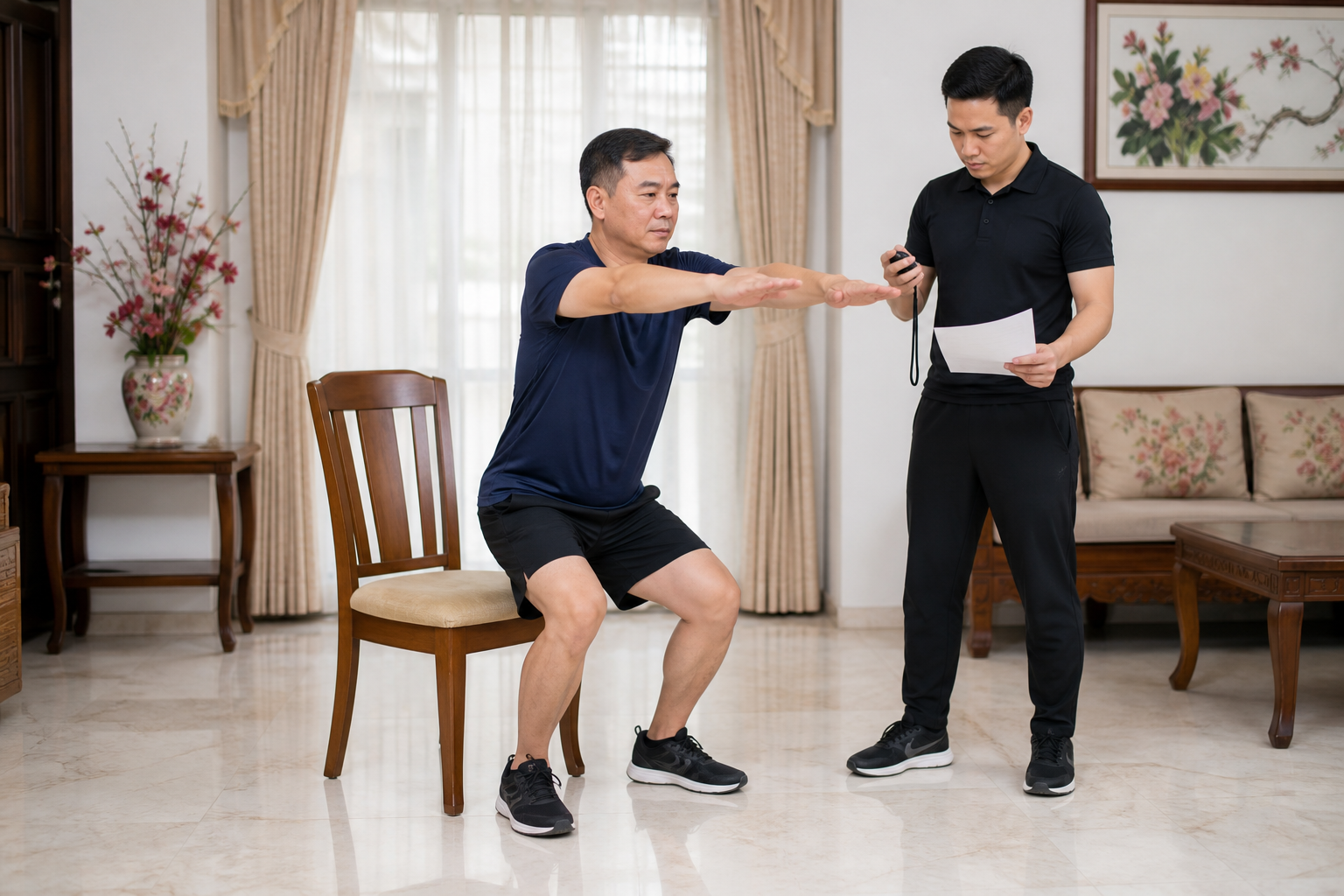
You can assess a lot with no equipment: the 30-second sit-to-stand for leg strength, single-leg balance time, a grip test, and the talk test for aerobic intensity. These functional tests predict real-world capability better than any single gadget.
Try the quick version with our functional-age self-check on the homepage, then get the real thing measured.
The biomarkers worth tracking
The most useful markers are the trainable ones (VO₂ max, muscle and grip strength, balance, and body composition), alongside the standard health numbers your doctor tracks: blood pressure, blood sugar (HbA1c) and cholesterol. Together they tell you how well you're ageing.
- VO₂ max: the strongest fitness predictor of lifespan. See VO₂ max training.
- Grip & strength: proxies for whole-body robustness. See grip strength and longevity.
- Balance: a key fall-risk indicator. See balance and stability.
DEXA, VO₂ max and wearables
For deeper data, DEXA scans (body composition and bone density) and lab VO₂ max tests are available at some Klang Valley clinics, and wearables can track heart-rate zones and resting heart rate. These are useful add-ons, not requirements. The field tests above get most people started.
The point of measuring
We build measurement into our method: a baseline, then a re-test every 12 weeks, so progress is something you read rather than hope for. If you'd like your real numbers measured at home, we run baseline assessments across KL and Selangor.
Written & reviewed by
Thurairaj ManoharanPhysiotherapist · 13+ years in healthcare
Paralysed by Guillain-Barré Syndrome as a teenager, Thurairaj rebuilt his body through physiotherapy, lived proof that the right movement, applied consistently, restores function.
How to Use Your Watch for VO₂ Max (Apple, Garmin & More)
Your smartwatch already estimates VO₂ max, one of the best longevity markers. How accurate it is, how to read the number, and how to actually improve it.
Read →The Longevity Biomarkers Worth Tracking
A few simple measures tell you more about your healthspan than the scale. The longevity biomarkers worth tracking, from a Klang Valley physiotherapist.
Read →Why the Scale Lies After 40 (and What to Track Instead)
Body weight tells you surprisingly little about your health and fitness after 40. Why the scale misleads, and better things to measure.
Read →6 At-Home Fitness Tests to Estimate Your Functional Age
Six simple fitness tests you can do at home with no equipment to estimate your functional age: sit-to-stand, balance, grip and more, with age benchmarks.
Read →HbA1c Explained: What Your Blood Sugar Number Means
HbA1c is the key number for blood sugar and diabetes risk. What it means, what is healthy, and how exercise improves it, from a Klang Valley physiotherapist.
Read →The 2-Minute Step Test: Check Your Aerobic Fitness at Home
The 2-minute step test is a simple way to gauge aerobic fitness and endurance without a gym. How to do it and track progress, from a Klang Valley physio.
Read →The Walking Speed Test: A Quiet Predictor of Healthy Ageing
How fast you walk says a lot about your health and longevity. How to measure gait speed at home and improve it, from a Klang Valley physiotherapist.
Read →How to Measure Your Blood Pressure at Home Properly
High blood pressure is common and often silent, and home monitoring helps you manage it. How to measure it accurately, from a Klang Valley physiotherapist.
Read →The Timed Up and Go Test: A Quick Check of Mobility and Fall Risk
The Timed Up and Go is a simple, clinic-proven test of mobility and fall risk you can do at home. How to do it and what your time means.
Read →The Single-Leg Balance Test: How Steady Are You?
How to test your balance by standing on one leg, what your time suggests about fall risk and healthy ageing, and how to improve it.
Read →Heart Rate Variability (HRV): A Window Into Recovery
Heart rate variability is a popular fitness-watch metric. What it means, how to use it sensibly for recovery and stress, and its limits.
Read →The Grip Strength Test: A Simple Window Into Healthy Ageing
How to test your grip strength, what it tells you about your healthspan, and how to build it: a quick, meaningful measure you can track.
Read →The Sit-to-Stand Test: Measure Your Leg Strength in 30 Seconds
How to do the 30-second sit-to-stand test, what your score means, and how to improve it: a simple home measure of leg strength and independence.
Read →Best Wearables for Longevity: Garmin vs Apple Watch vs Whoop vs Oura
What longevity metrics wearables can actually track, how the main options compare, and whether you need one at all to train for healthspan.
Read →Biological-Age Testing: Hype or Genuinely Helpful?
Biological-age and epigenetic tests promise to reveal how old you really are. What the evidence supports, the cost, and why trainable markers matter more.
Read →DEXA & Body-Composition Scans in Malaysia: Cost & Where
A DEXA scan shows bone density, muscle and visceral fat: key longevity markers. Here's where to get one in the Klang Valley and what it costs in ringgit.
Read →Waist-to-Height Ratio: The Simplest Health Number You Can Track
Your waist-to-height ratio is a quick, honest measure of harmful belly fat, often better than BMI. How to measure and improve it.
Read →Health Screening & Blood Tests Worth Asking For as You Age
Which health screening and blood tests matter as you age in Malaysia: blood pressure, HbA1c, lipids and more, where to get them and what they cost.
Read →Where to Get a VO2 Max Test in Malaysia (And the Cost)
VO2 max is one of the best predictors of longevity. Here's where to test it in the Klang Valley, realistic ringgit costs, and how to improve the number.
Read →Frequently asked questions
What fitness tests can I do at home?
Several useful ones need no equipment: the 30-second sit-to-stand (lower-body strength), single-leg balance time, a grip test, and the talk test for aerobic intensity. Together they give a rough picture of your functional fitness.
What longevity biomarkers are worth tracking?
The most actionable are the ones you can train: VO₂ max, muscle strength (including grip), balance, and body composition, plus standard health markers like blood pressure, blood sugar (HbA1c) and cholesterol from your doctor.
Where can I get a DEXA or VO₂ max test in Malaysia?
Some private clinics and sports-science labs in the Klang Valley offer DEXA body-composition scans and treadmill VO₂ max testing. You don't need a lab to start, though. We estimate your key markers at a home baseline and track change from there.
Find out where you really stand.
A physiotherapist-led baseline at home, re-tested every 12 weeks.
Start with a free, no-obligation chat on WhatsApp
Home visits across Kuala Lumpur & Selangor (Klang Valley) · in-centre by appointment, Putra Heights