Strength training for longevity
Muscle is the organ of longevity. Here's why it predicts how long you stay independent, and how to build it safely after 40, 60 and beyond.
Written & reviewed by Thurairaj Manoharan, physiotherapist · Updated
If you train only one thing for a longer, more independent life, train strength. Muscle is not just for movement. It's a metabolic organ, a glucose sink, a shock absorber for your joints, and the difference between getting off the floor unaided at 85 or not.
Why muscle mass predicts how long you'll live
Higher muscle strength is consistently associated with lower all-cause mortality. Strong people fall less, recover from illness and surgery faster, manage blood sugar better, and keep their independence longer.
Grip strength, a simple proxy for whole-body strength, is one of the cleaner predictors of longevity in the research. The mechanism is intuitive: strength is what lets you carry, climb, rise and catch yourself, and those abilities decide whether ageing is active or fragile.
Sarcopenia: the muscle loss that steals independence
From around 40, adults lose muscle each decade, accelerating after 60. This is sarcopenia, the quiet engine behind frailty and falls. The good news: resistance training reverses much of it, even late in life.
Sarcopenia rarely announces itself. It shows up as a chair becoming harder to rise from, a jar harder to open, a stumble that used to be a non-event. Because the loss is gradual, most people accept it as "just getting older", when it's actually one of the most trainable problems in medicine.
How to train strength for longevity
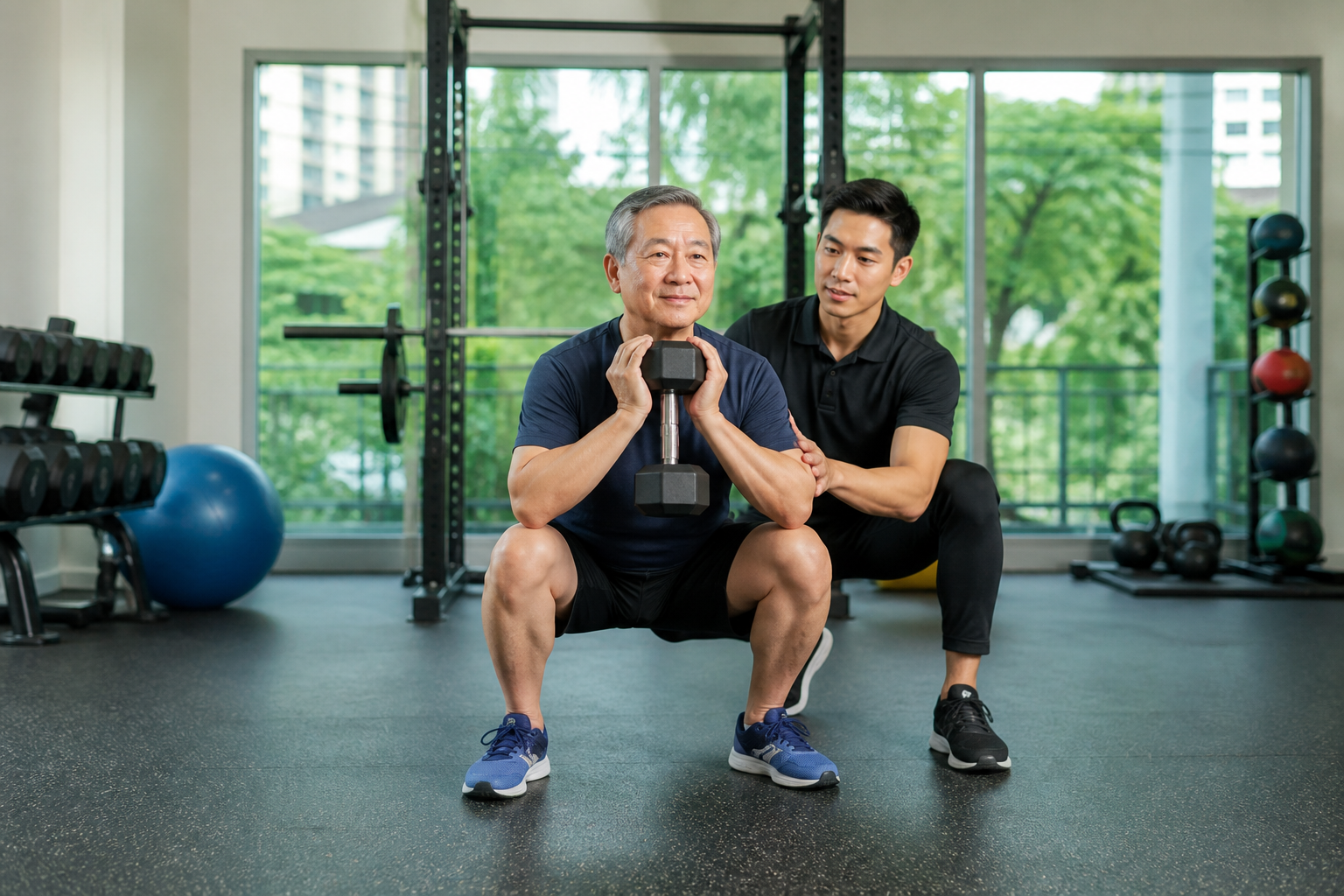
Train two to three times a week, focus on compound movements that mirror real life (squat-to-stand, hinge, push, pull, carry), and apply progressive overload, gradually doing a little more over time. Form and progression matter far more than intensity.
- Compound first: sit-to-stand, step-ups, rows, presses and carries train the patterns you use to live independently.
- Progressive overload: add a rep, a little load, or a harder variation as you adapt. This is what keeps muscle growing.
- Recover: muscle is built between sessions. Sleep, protein and rest days are part of the programme, not optional extras.
This pillar works alongside the other three. See how they fit together in the complete longevity exercise guide. If you have a condition like diabetes, arthritis or high blood pressure, read exercising safely with a chronic condition first.
Doing it safely as you age
Strength training is very safe when started gently, dosed correctly and supervised, which is exactly why a physiotherapist-led, home-based approach suits older adults and complete beginners.
We begin below your limit, build technique before load, and progress only when the previous step is solid. If you have osteoporosis, joint replacements or a heart condition, we adapt the plan and coordinate with your doctor. This page is educational, not medical advice. See our disclaimer.
The Malaysian angle
Strength training is the pillar least affected by our heat and haze. It's done indoors, at home, in any weather. That makes it the perfect anchor for a Malaysian longevity plan: reliable, year-round, and effective with minimal equipment in a condo or terrace house.
Written & reviewed by
Thurairaj ManoharanPhysiotherapist · 13+ years in healthcare
Paralysed by Guillain-Barré Syndrome as a teenager, Thurairaj rebuilt his body through physiotherapy, lived proof that the right movement, applied consistently, restores function.
Strength Training at Home in Malaysia (Minimal Equipment)
How to build serious strength at home with little or no equipment: what to buy, what to skip, and how home training removes the biggest barrier to consistency.
Read →Progressive Overload, Explained Simply for Older Adults
Progressive overload is how strength improves. What it means, how to apply it safely after 50, and signs of doing too much, from a Klang Valley physio.
Read →How to Get Up From the Floor (and Why It Matters)
Getting off the floor easily is a clear sign of an independent body. How to practise it safely and the strength behind it, from a Klang Valley physio.
Read →Power Training for Longevity: The Quality That Fades Fastest
Why muscular power declines faster than strength as you age, why it matters for falls and independence, and how to train it safely after 50.
Read →Bone Density & Osteoporosis: How Lifting Protects Your Skeleton
Why bone density matters for longevity, how strength and impact training build and protect bone, and what this means for women after menopause.
Read →The Best Longevity Strength Exercises (Compound Movements)
The compound movements that build real-world strength for longevity (squats, hinges, pushes, pulls, carries) and why they beat machines and isolation work.
Read →How to Do a Glute Bridge: Wake Up the Muscles That Protect Your Back
The glute bridge strengthens your hips and backside, supports your back and is gentle enough for almost anyone. How to do it well.
Read →How to Do a Farmer's Carry: Strength, Grip and Posture in One
Carrying something heavy as you walk builds grip, core and whole-body strength at once. How to do the farmer's carry safely, from a Klang Valley physio.
Read →How to Do Step-Ups: Build Strength for Stairs and Independence
The step-up trains the exact strength you need for stairs, kerbs and getting up from the floor. How to do it safely and progress it.
Read →Strength vs Cardio for Longevity: Which Matters More?
Strength and cardio protect you differently, and a long, healthy life needs both. How to balance them, from a Klang Valley physiotherapist.
Read →How to Do a Wall Push-Up: Upper-Body Strength for Beginners
The wall push-up is the safest way to start building upper-body and chest strength at any age. How to do it well and progress it.
Read →How to Do a Hip Hinge: The Movement That Protects Your Back
The hip hinge is the safe way to bend, lift and pick things up. How to do it correctly, the common mistakes, and how to build it.
Read →Strength Training for Beginners Over 40: A Safe On-Ramp
A true beginner's guide to lifting after 40: why it's safe and high-value, the key compound movements, starting light, and a simple weekly structure.
Read →How Much Protein You Really Need After 50 (Malaysian Foods Included)
How much protein to build and keep muscle after 50, how to spread it across the day, and where to get it from everyday Malaysian foods.
Read →Sarcopenia: The Muscle Loss That Steals Your Independence
What sarcopenia is, why it accelerates after 60, and how to prevent and reverse it at any age: a clear guide from a Klang Valley physiotherapist.
Read →How to Do a Step-Down: Control for Stairs and Knees
The step-down trains the controlled lowering your knees need for stairs and slopes, a common weak point with age. How to do it safely.
Read →Grip Strength: The Longevity Biomarker You Can Actually Train
Why grip strength predicts how long you'll live, what a healthy grip looks like by age, and simple ways to build it, from a Klang Valley physiotherapist.
Read →How to Do a Resistance Band Row: Stronger Back and Posture
The band row builds upper-back strength and counters the forward slump of modern life. How to do it, from a Klang Valley physiotherapist.
Read →How to Do a Suitcase Carry: Core Strength You Can Feel
The suitcase carry builds a strong, stable core and protects your spine by training you to resist leaning, from a Klang Valley physiotherapist.
Read →Eccentric Training: The Gentle Way to Build Strong, Resilient Joints
Slowing the lowering phase of an exercise builds strength and resilient tendons, kindly on the joints. What eccentric training is and how to use it.
Read →How to Do a Squat Safely (Especially Over 50)
The squat is the king of lower-body exercises and the basis of rising from a chair. How to do it well and scale it to you, from a Klang Valley physio.
Read →How to Lift Weights Safely as You Age
Strength training is one of the best things you can do as you age, and it is safe when done well. Lifting without injury, from a Klang Valley physio.
Read →Sets, Reps and Rest: Simple Strength Programming After 50
How many sets, how many reps, how much rest? A clear, no-jargon guide to programming your strength training after 50, from a Klang Valley physiotherapist.
Read →Safe Power Exercises for Older Adults
Power training keeps you quick and steady, and it can be done safely at any age. A set of gentle, scalable power exercises, from a Klang Valley physiotherapist.
Read →Rucking for Longevity: Weighted Walking for More Benefit
Rucking, walking with a weighted backpack, turns an ordinary walk into strength and cardio in one. How to start safely in the Malaysian climate.
Read →Why Power Matters More Than Strength After 60
After 60, how fast you produce force may matter more than how much you can lift. Why power is the priority and how to train it, from a Klang Valley physio.
Read →Frequently asked questions
How often should an older adult strength train?
Two to three sessions a week is the sweet spot for most adults over 50, enough to build and maintain muscle, with recovery in between. We start with two and progress as your baseline allows.
Will lifting weights make me bulky or hurt my joints?
No. Building noticeable bulk takes years of dedicated effort; what most people gain is strength, bone density and joint stability. Done with correct form and progression, strength training protects joints. It's a leading treatment for knee and back pain, not a cause of it.
What is sarcopenia and can I reverse it?
Sarcopenia is the age-related loss of muscle that begins around 40 and accelerates after 60. It's a major driver of frailty and falls, and it's largely reversible: supervised resistance training rebuilds muscle and strength even in your 70s and 80s.
Do I need a gym full of equipment?
No. We bring what's needed and use your own space and bodyweight, bands and adjustable weights. Premium home visits across KL and Selangor mean effective strength training without a gym membership or the traffic.
How much protein do I need to build muscle after 50?
Older adults generally need more protein than younger ones, roughly 1.2–1.6g per kg of bodyweight a day, spread across meals, to build muscle effectively. We tailor this to your body and your real Malaysian diet rather than handing you a generic chart.
Build strength that keeps you independent for decades.
Home-visit strength coaching across KL & Selangor, led by a physiotherapist.
Start with a free, no-obligation chat on WhatsApp
Home visits across Kuala Lumpur & Selangor (Klang Valley) · in-centre by appointment, Putra Heights