The longevity mindset: habits that last decades
Knowing what to do is the easy part. Lasting for decades takes systems, the right goals and a plan for missed sessions.
Written & reviewed by Thurairaj Manoharan, physiotherapist · Updated
Longevity training is a decades-long project. NHMS 2023 found about 3 in 10 Malaysian adults (29.9%) physically inactive, so the barrier is rarely knowledge. People who last tend to have a system that survives a busy week, a holiday and a flat day.
Systems beat motivation
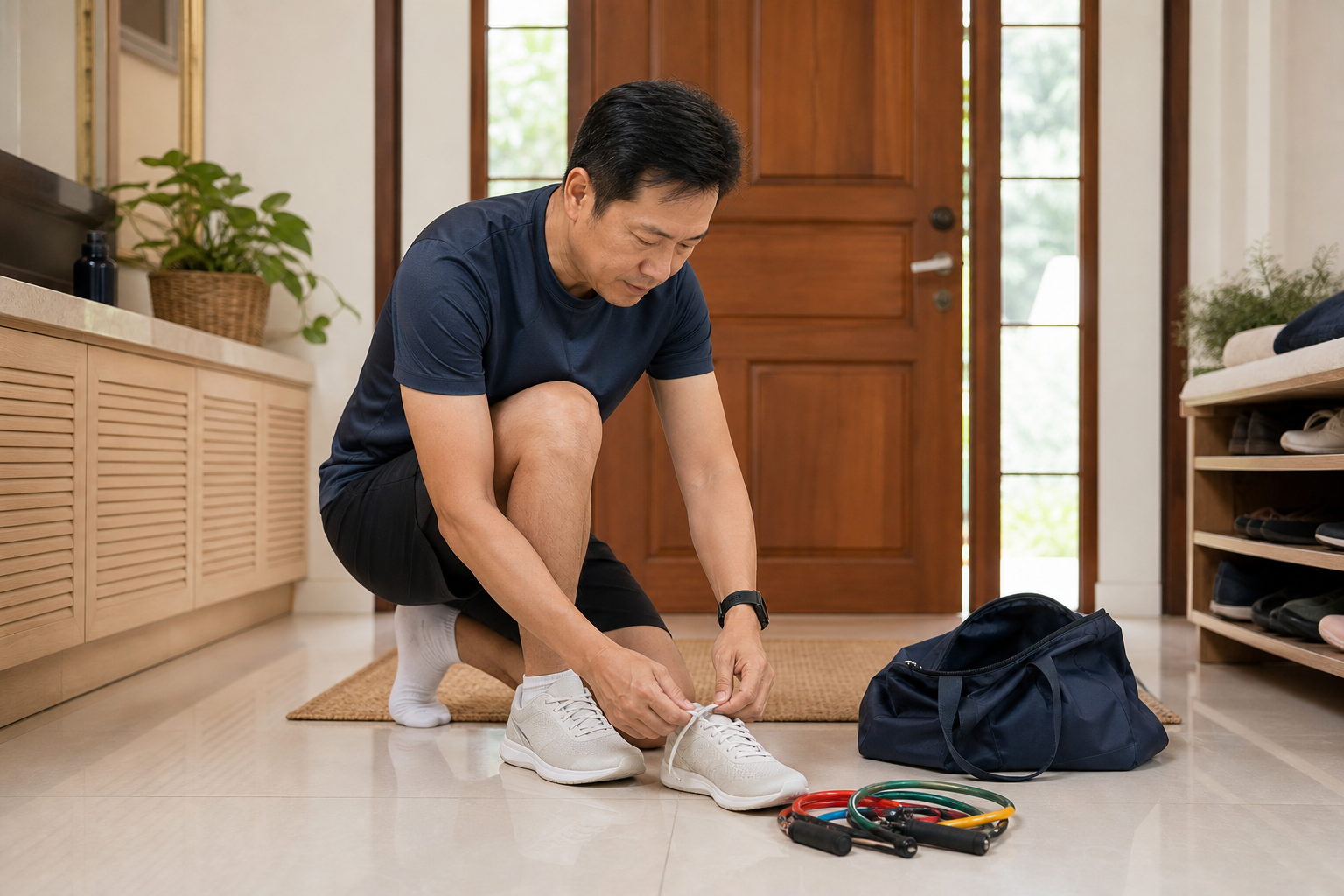
Motivation is unreliable. Durable habits are small, attached to an existing routine and easy enough to do on a flat day. In a UCL study of 96 volunteers, a new daily behaviour took 66 days on average to become automatic, with a range from 18 to 254 days, and missing a single day did not derail the process (Lally et al., 2010).
Training at home removes the biggest friction of all. See why in how to build an exercise habit.
Set functional goals, not vanity goals
The most motivating goals are concrete capabilities: getting off the floor unaided, climbing stairs without the rail, carrying groceries up from the car park. These are measurable and tied to the life you want at 80.
This is the idea behind the Centenarian Decathlon in our complete guide.
Plan for the misses
You will miss sessions: to travel, illness, work, the haze. That's normal, not failure. The trap is letting one miss become ten. The single most useful habit is the restart: do one short session today, and you're back.
Accountability that works
Seeing your own numbers improve is a durable source of motivation, which is why our method re-tests your baseline every 12 weeks. Coaching adds the accountability most people need to bridge the gap between knowing and doing. We bring it to your home across the Klang Valley.
References
- Lally P et al. (2010). How are habits formed: modelling habit formation in the real world. Eur J Soc Psychol. - European Journal of Social Psychology
- Bull FC et al. (2020). World Health Organization 2020 guidelines on physical activity and sedentary behaviour. Br J Sports Med. - British Journal of Sports Medicine
- National Health and Morbidity Survey 2023 in Malaysia: methodology and main findings on non-communicable diseases (2025). Sci Rep. - Scientific Reports
- Westcott WL (2012). Resistance training is medicine: effects of strength training on health. Curr Sports Med Rep. - Current Sports Medicine Reports
Written & reviewed by
Thurairaj ManoharanPhysiotherapist · 13+ years in healthcare
Paralysed by Guillain-Barré Syndrome as a teenager, Thurairaj rebuilt his body through physiotherapy, lived proof that the right movement, applied consistently, restores function.
Group class vs fitness app vs coach: what actually keeps you going
Group class, fitness app or personal coach? What research says about sticking with exercise after 40, with Malaysian tips and a simple way to choose.
Read →How to Persuade a Reluctant Older Parent to Exercise
Why parents resist exercise and what works: listening first, small asks, doing it together, framing around independence and when to get professional help.
Read →Sitting and Longevity: Is Sitting Really the New Smoking?
Long hours of sitting raise health risks, but exercise can offset much of the harm. What the evidence says and how to break up a desk day in Malaysia.
Read →Staying Consistent With Exercise When Life Gets Busy
How to keep exercising through a busy schedule: shrink sessions, anchor them to routines, plan for disruptions and restart quickly after a lapse.
Read →How to Build an Exercise Habit That Actually Lasts
Habits take about two months to form, not 21 days. How to start small, anchor exercise to your day and restart after a miss, with a Malaysian slant.
Read →Overcoming the 3 Big Excuses: No Time, Too Old, Too Unfit
Practical, evidence-based answers to the three biggest reasons people skip exercise, with the minimum that helps, for busy Malaysian adults.
Read →Building Fitness Confidence After 40
Feel too unfit, too old or too self-conscious to start? A gentle 4-week plan to build exercise confidence after 40, at home and without needing a gym.
Read →Set Functional Goals, Not Vanity Goals
Training for what your body can do keeps you motivated and independent. How to set functional goals, with measurable examples, benchmarks and weekly plans.
Read →How to Exercise When You Have No Motivation
Motivation comes and goes. Use a 5-minute rule, fixed cues and a low-day plan to keep training when you do not feel like it, from a Klang Valley physio.
Read →How to Restart Exercise After a Long Break
Back after weeks, months or years away? Start at about half your old effort, rebuild the habit first, then progress over 8 weeks without injury or burnout.
Read →Frequently asked questions
How do I stay consistent with exercise when life gets busy?
Make it small and automatic. Anchor a short session to an existing routine, lower the friction (training at home helps), and protect a non-negotiable minimum even in busy weeks. Systems beat motivation.
How do I set the right goals?
Set functional goals, not vanity ones: 'get off the floor unaided at 80', 'climb two flights without the rail', 'carry the groceries up'. Concrete capability goals are more motivating and more meaningful than a number on a scale.
How do I restart after falling off?
Lower the bar and just do one short session today. Missing a stretch is normal and doesn't undo your progress. The people who last are the ones who always restart, not the ones who never stop.
Turn good intentions into a habit that sticks.
Coaching and accountability around your real life, across KL & Selangor.
Start with a free, no-obligation chat on WhatsApp
Home visits across Kuala Lumpur & Selangor (Klang Valley) and Ipoh · in-centre by appointment, Putra Heights