The farmer's carry builds grip, core and posture by walking with weight in both hands. Steps, loads, mistakes and safety from a Klang Valley physio.
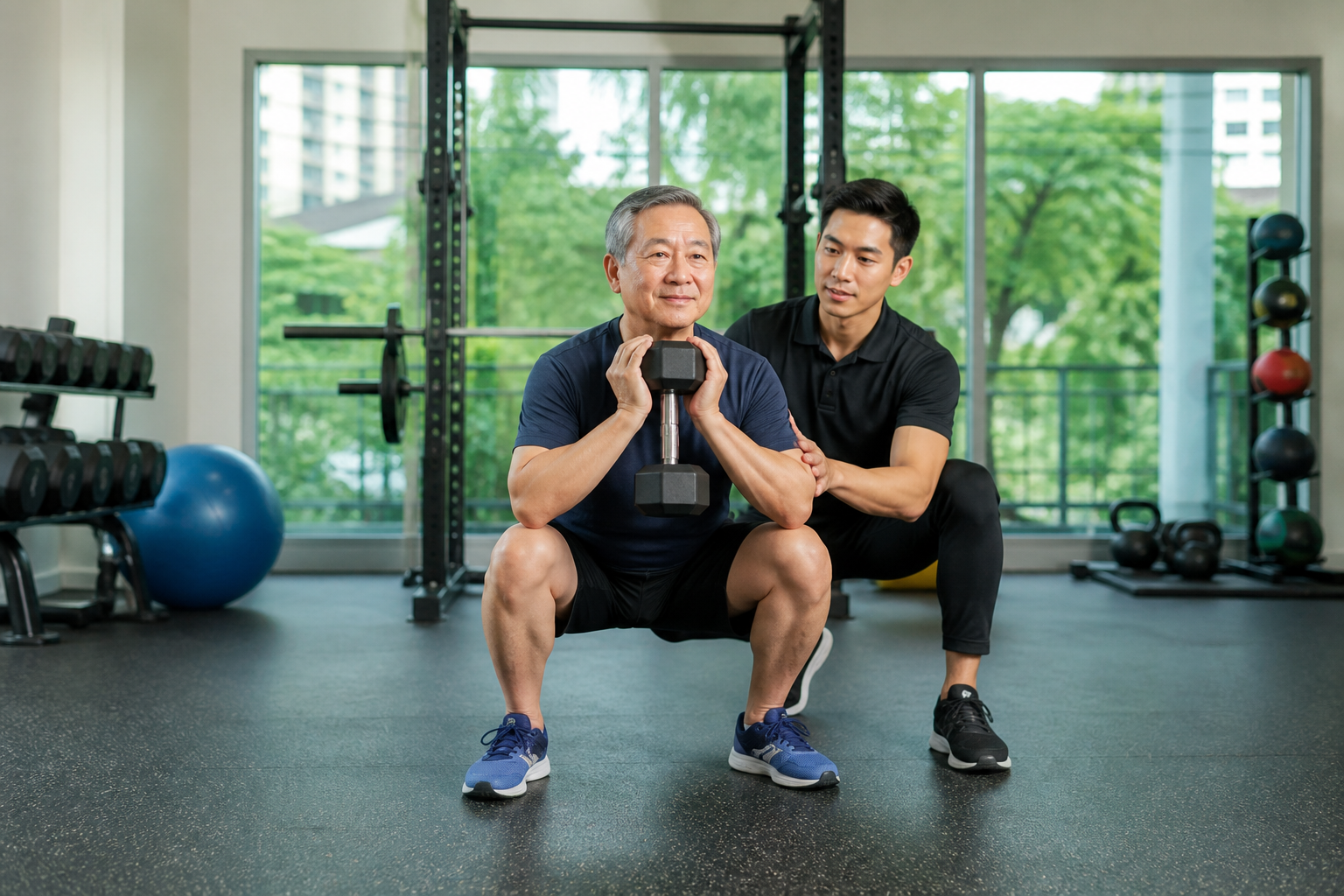
The farmer’s carry is simply walking while holding a weight in each hand. It trains grip, upper back, core, hips and legs together, and it copies a task you already do, carrying shopping. Start with a weight you can carry for 20 to 40 seconds while standing tall, and build up slowly.
Why is the farmer’s carry worth doing?
Few exercises give as much for so little complexity.
- Grip strength. In the large international PURE study, weaker grip was linked to a higher risk of death from any cause, and of cardiovascular disease, over about four years. Grip is a marker rather than a magic muscle, but it is easy to train and carries over into daily tasks. See grip strength and longevity.
- Posture. Holding a load at your sides pulls the shoulders down and challenges the upper back to keep you upright, which counters desk-posture slump.
- Core stability. Your trunk muscles work constantly to stop you swaying or leaning as you step.
- Walking with load. It improves the strength and coordination used for carrying bags up kerbs and stairs, and it matches the recommendation that older adults train strength and balance together.
For adults, the WHO guidelines call for muscle-strengthening on two or more days a week. Carries fit comfortably at the end of a session.
How to do a farmer’s carry step by step
- Choose your weight. Two dumbbells, two kettlebells, or two water jugs or grocery bags. Start light.
- Clear the path. Pick a flat, non-slip stretch of 8 to 10 metres, such as a corridor, car porch or a straight line in your garden.
- Pick the weights up with a hinge. Use a flat-back hip hinge, with weights close to your feet, and stand up by driving your hips forward.
- Set your posture. Chest tall, shoulders down and back, ribs stacked over your hips, eyes forward, core gently braced.
- Walk. Take controlled steps of normal length for 20 to 40 seconds or 10 to 20 metres, with the weights hanging still at your sides.
- Turn and return, or set down. Lower the weights with a hinge, not a rounded back.
- Rest 60 to 90 seconds and repeat for three to four carries in total.
Breathe normally. Do not hold your breath.
How heavy should it be?
| Level | Load in each hand | Distance or time |
|---|---|---|
| First week | Light: 2 to 5 kg or two grocery bags | 10 to 15 metres, 3 rounds |
| Building | Moderate: about 10 to 15 percent of body weight | 20 to 30 seconds, 3 to 4 rounds |
| Stronger | About 20 percent of body weight or more | 30 to 40 seconds, 4 rounds |
These are starting points, not targets. The correct weight is the one that keeps your posture tall and your shoulders level to the last step. If the load pulls you into a lean or your grip gives out within 10 seconds, go lighter. Progress by adding distance first, then a small amount of weight.
Common mistakes
- Leaning or slumping. Heavy loads can pull the shoulders forward. If you cannot stay tall, the weight is too heavy.
- Shrugging the shoulders to the ears. Keep them set down and back.
- Rounding the back to pick up or put down. Hinge, do not bend from the waist.
- Taking tiny shuffling steps or rushing. Walk at a natural pace with control.
- Gripping so hard you hold your breath. Keep a firm but relaxed hold and breathe.
Easier and harder versions
Easier
- Lighter load or shorter distance.
- A carry with one weight, called a suitcase carry. Swap sides each set.
- Walk beside a wall or kitchen counter you can touch if you wobble.
Harder
- Heavier weights, longer distance or timed rounds.
- Carry with a pause and a turn in the middle.
- Rack the weights at your shoulders (front-loaded carry) for more trunk demand.
- Walk up and down a gentle slope or a few stairs, only when you are confident and have a clear railing.
Where does it fit in your week?
Do farmer’s carries two to three times a week, usually at the end of a strength session when your legs are tired but your grip is still working. They pair well with the resistance band row for the upper back and the glute bridge for the hips. In daily life, try carrying two bags instead of one. Check your own numbers with the strength standards tool.
Keep it safe
- Use a clear, flat path with no wet tiles. After rain or in a car park, be careful of slippery surfaces.
- Choose weights with handles that will not slip, especially in humid weather when palms get sweaty.
- Do not carry heavy loads if you are dizzy, have uncontrolled high blood pressure, or have been told to avoid heavy lifting after surgery or a hernia.
- If you have a back, shoulder, wrist or hand condition, begin with light loads and get guidance.
- Stop for sharp pain, chest discomfort, unusual breathlessness or numbness in the hands.
Key takeaways
- The farmer’s carry trains grip, posture, core and gait together, and it matches real life.
- Pick a weight you can carry for 20 to 40 seconds while standing tall, with level shoulders.
- Pick up and set down with a hip hinge, and progress distance before weight.
- Do three to four carries, two to three times a week, as part of a wider strength routine.
- Stop for sharp pain, dizziness or chest symptoms and seek advice.
If you would like carries built into a progressive plan that fits your joints and goals, we run home-visit assessments across KL and Selangor.