Build real strength at home in Malaysia with little equipment: what to buy and skip, a simple weekly plan, progression and when to get help.
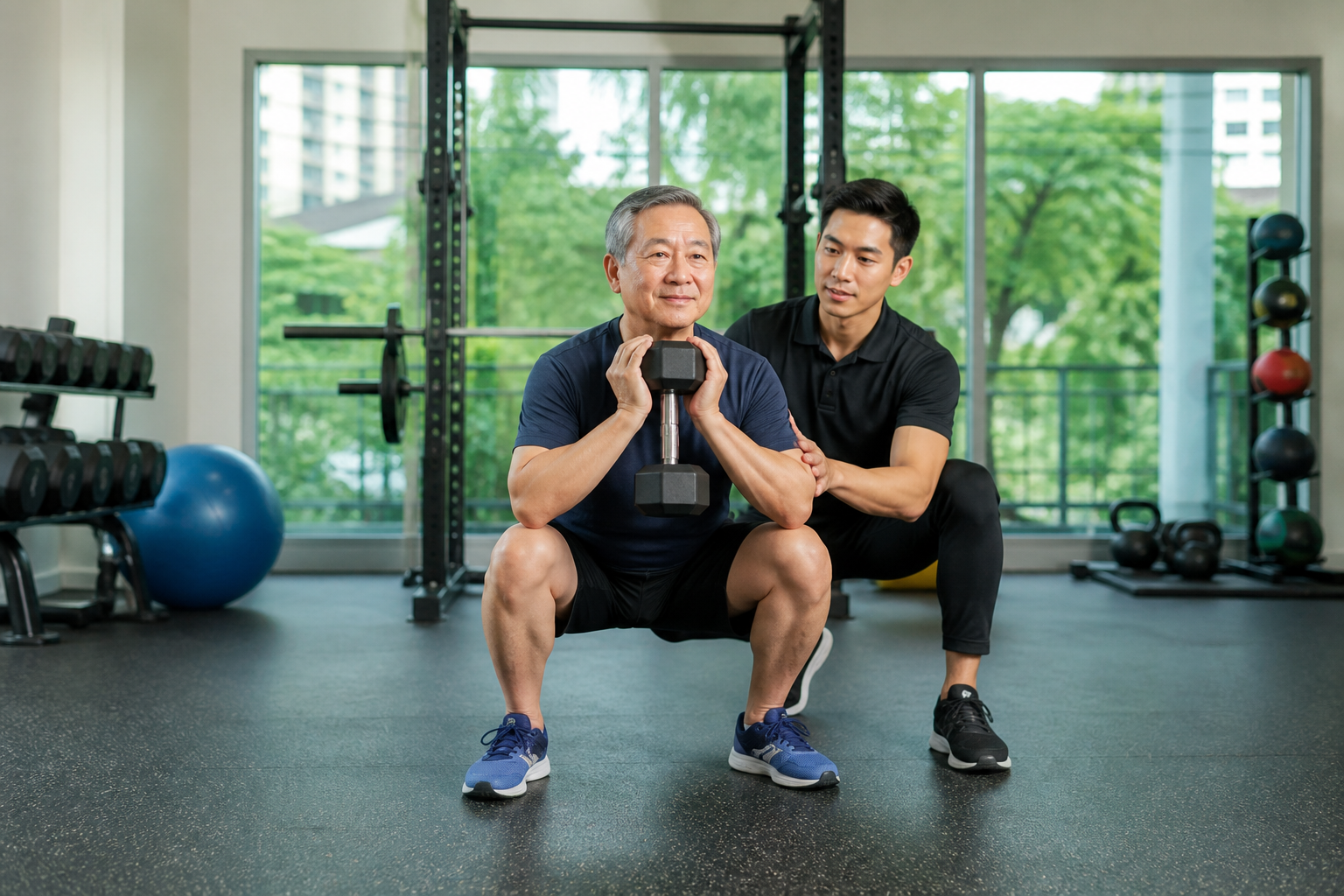
Yes, you can build real strength at home with very little equipment: your bodyweight, a sturdy chair, a few resistance bands and one adjustable pair of dumbbells are enough to train every major movement pattern for years. Two or three sessions of 30 to 45 minutes a week meet the WHO recommendation for muscle-strengthening, and home training removes the friction, such as traffic, parking and queues, that ends many gym habits.
Does home training build as much muscle as a gym?
Muscle growth does not require very heavy weights. A meta-analysis of 21 studies found that gains in muscle size were similar between low-load and high-load training, while maximal strength (a one-repetition max) improved more with heavy loads (Schoenfeld et al., 2017). A later network meta-analysis of 28 studies found the same pattern: no difference in hypertrophy between loads, and better strength gains with moderate and high loads than low loads (Lopez et al., 2021).
For most adults, this means light-to-moderate home equipment works for muscle, provided you train hard enough: sets that finish within a few repetitions of fatigue. If your main goal is maximal strength, you will eventually want heavier loads, which a gym or heavier dumbbells provide. For a comparison, see gym vs home training.
What equipment do I actually need?
| Stage | Equipment | Approximate cost |
|---|---|---|
| Beginner | Bodyweight, sturdy chair, a wall | Free |
| Early progress | Set of resistance bands, a mat | Low, under RM150 |
| Ongoing | One adjustable dumbbell pair or a kettlebell | Moderate, a few hundred ringgit |
| Optional | Pull-up bar, bench, backpack for loaded carries | Optional |
Prices vary by brand and shop, so check current listings. Skip the gadgets that promise shortcuts. A loaded backpack, a filled water jug or a bag of rice also works as resistance. See building a home gym in Malaysia for buying advice that suits condo and landed-house spaces.
Which exercises should I do?
Longevity strength comes from a few compound patterns. For each pattern, a home version:
- Squat: sit-to-stand from a chair, then goblet squat with one dumbbell (how to do a squat).
- Hinge: hip hinge or glute bridge with a band or dumbbell.
- Push: wall push-up, then incline push-up on a table, then floor push-up.
- Pull: resistance band row anchored to a door (how to do a resistance band row).
- Carry: carrying shopping bags or two dumbbells around the house.
- Single-leg work: step-ups on a stair or sturdy step.
The full list and technique cues are in the best longevity strength exercises.
What does a week look like?
- Session A, 35 minutes. Warm up for 5 minutes. Goblet squat 3 x 8 to 12, band row 3 x 10 to 12, incline push-up 3 x 8 to 12, glute bridge 2 x 12 to 15, farmer’s carry 3 x 30 seconds.
- Session B, 35 minutes. Warm up. Step-up 3 x 8 per leg, hip hinge with dumbbell 3 x 8 to 12, band press or overhead press 3 x 8 to 12, band row 2 x 12 to 15, plank 2 x 20 to 30 seconds.
- Alternate A and B on two or three non-consecutive days, and add a brisk walk on other days.
Rest 60 to 90 seconds between sets. Stop each set with two or three repetitions in reserve, and adjust to your level.
How do I progress?
Progressive overload is the engine. Once you can complete all sets at the top of the rep range with good form, make one change:
- Add 1 to 2 kg, or use a stronger band.
- Add a repetition or a set.
- Slow the lowering phase to about 3 seconds.
- Move to a harder variation, such as a deeper squat or a floor push-up.
Change only one variable at a time and log your sessions. Our guide to progressive overload for older adults goes further.
Why is home training useful in Malaysia?
Heat, humidity, haze and sudden storms make outdoor training unreliable. Strength work at home is not affected by them, so it keeps going on days when outdoor cardio is not practical. Training in a fan-cooled or air-conditioned room also lets you manage the heat, which matters for hydration and recovery; see exercising in Malaysia’s heat and humidity. On haze days, the options in should you exercise during the haze apply.
When should I get advice first?
Check with a doctor or physiotherapist before starting if you have heart disease, uncontrolled high blood pressure, recent surgery, significant joint pain, osteoporosis with previous fractures, or dizziness. Stop and seek help for chest pain, severe breathlessness, fainting or sharp, worsening joint pain. Mild muscle soreness for a day or two is normal. See when to get medical clearance before exercise.
Key takeaways
- Bodyweight, a chair, bands and one pair of adjustable dumbbells are enough to build real strength at home.
- Muscle growth is similar across a range of loads when sets are close to fatigue, though heavier loads give more maximal strength.
- Two or three full-body sessions a week meet the WHO muscle-strengthening guideline.
- Progress by adding reps, load, tempo or a harder variation, one change at a time.
- Home training is weather-proof and removes the travel barrier that stops many people.
If you want the movements set up correctly and progressed safely, our home visits match a plan to your space and level, across the Klang Valley.