A 30 to 40 minute no-equipment home workout for condos and hot or hazy days: strength, balance and indoor cardio, with progressions for all levels.
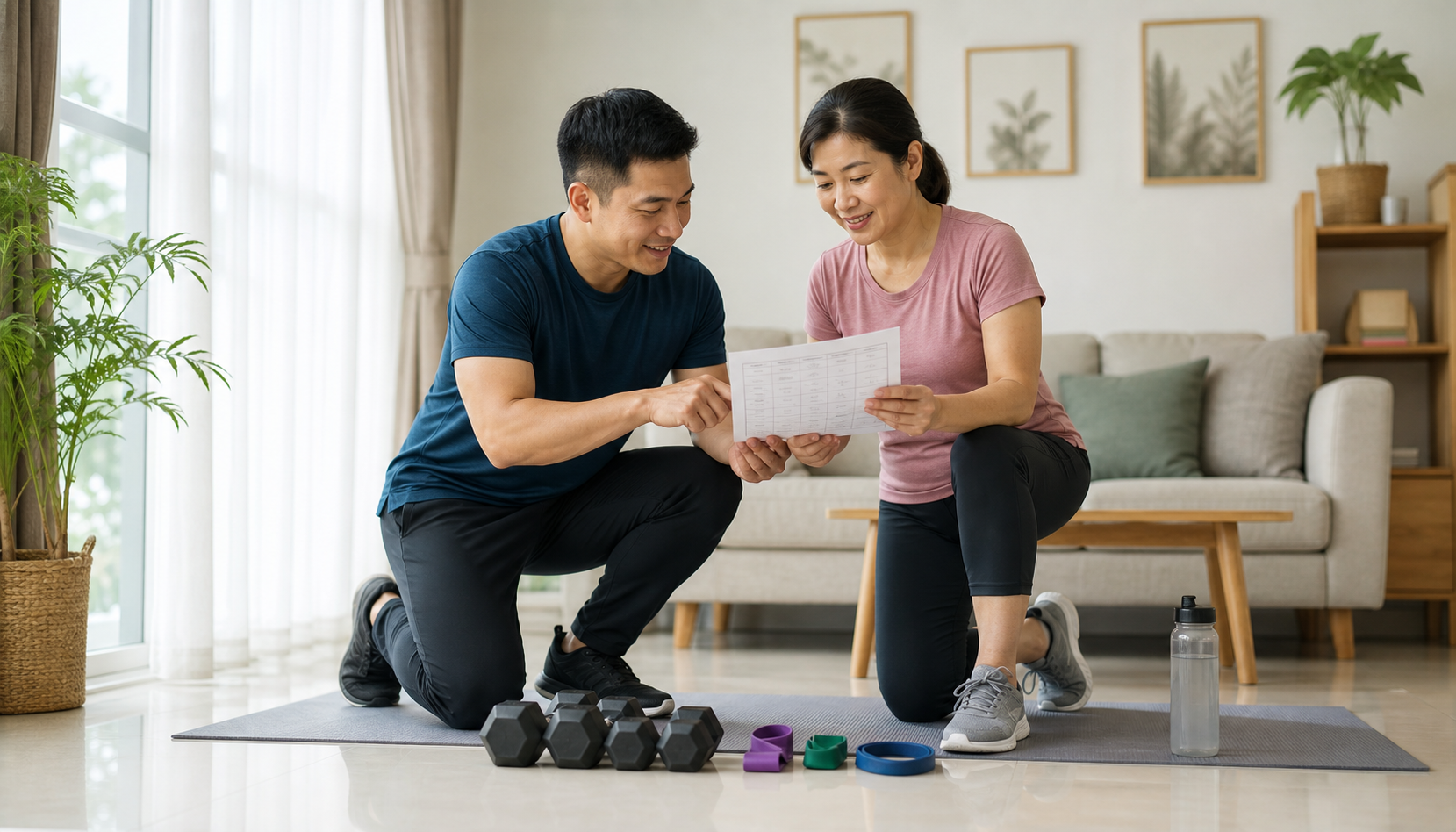
A no-equipment home workout can cover strength, balance and cardio in 30 to 40 minutes, two or three times a week. You need a wall, a sturdy chair and one stair. It works in a small condo, during the haze, and on afternoons too hot for the park, and it meets the WHO targets when combined with indoor walking on other days.
Why bodyweight training works
Strength gains depend mainly on working muscles hard enough, not on the weight you hold. A meta-analysis comparing lighter and heavier loads found similar muscle growth when sets were taken close to fatigue, with heavier loads giving somewhat larger strength gains. For beginners and older adults, bodyweight work is enough to start, and the way to keep progressing is more reps, slower tempo or harder variations. Resistance-training guidance for older adults emphasises progressive loading, and the WHO advises muscle-strengthening on at least two days a week. Balance and functional exercises also reduce falls, as the Cochrane review of exercise for fall prevention found.
Before you start
Check with your doctor if you have heart disease, chest pain, uncontrolled blood pressure, dizziness, or recent surgery. Clear the floor, wear non-slip shoes (tiles get slippery when you sweat), and keep a chair and a wall within reach. Warm up for five minutes: march on the spot, roll your shoulders, do slow half-squats and hip circles. Sharp pain means stop.
Strength block (about 15 minutes)
Run through the four exercises as a circuit, resting 30 to 60 seconds between exercises and 1 to 2 minutes between rounds.
| Exercise | Beginner | Harder progression |
|---|---|---|
| Sit-to-stand or squat. See how to do a squat | 2 x 10 from a chair | 3 x 15 full squats, 3 seconds down |
| Push-up. See wall push-up | 2 x 8 against the wall | 3 x 10 hands on a sofa, then floor |
| Glute bridge. See glute bridge | 2 x 12 | 3 x 15, then single-leg |
| Reverse lunge | 2 x 6 each leg holding a chair | 3 x 10 each leg, no support |
Add 2 reps a week until you reach the top of the range, then move to the harder column. Stop each set with about two reps left in reserve at first. For more variations, see strength training at home in Malaysia.
Balance block (about 5 minutes)
- Single-leg stand. Hold the counter. Beginner 15 seconds each side, then 30 seconds, then with fingertips only. See single-leg stand.
- Heel-to-toe walk. 10 steps along a line, then backwards. See heel-to-toe walk.
- Calf raises. 2 x 12, then on one leg. See calf raises.
Indoor cardio (20 to 45 minutes)
On non-strength days, build a conversational-pace session. This is Zone 2 cardio, indoors.
- March on the spot for 2 minutes with arms swinging.
- Step up and down a single stair for 2 minutes, switching lead leg halfway.
- Walk laps of your home or corridor.
- Repeat for 20 to 45 minutes in total. You should breathe faster but still speak in short sentences.
Play music or a podcast. If you want a harder session once or twice a week and your doctor agrees, do 6 rounds of 30 seconds of fast step-ups followed by 60 seconds easy. See indoor exercise for hot and hazy days and how to find your Zone 2.
Haze and heat
When the Air Pollutant Index reaches unhealthy levels, move indoors, keep windows closed, and avoid hard outdoor exercise. See should you exercise during the haze. In heat, drink water before and after, use a fan or air-conditioning, and stop if you feel faint, nauseous or stop sweating. See exercising in Malaysia’s heat and humidity.
A simple week
| Day | Session |
|---|---|
| Monday | Strength and balance blocks |
| Tuesday | 20 to 30 minutes indoor Zone 2 |
| Wednesday | Rest or gentle mobility |
| Thursday | Strength and balance blocks |
| Friday | 30 to 45 minutes indoor Zone 2 or intervals |
| Saturday | Strength block, or outdoor walk if the air is good |
| Sunday | Rest |
Our beginner’s weekly longevity workout plan and 30-minute longevity workout offer other layouts.
When to progress
Move on when you can complete all sets with good form and about two reps left in reserve. Slow the tempo, pause at the bottom, add reps, or use a backpack with books for load. If you would rather add weights, see building a home gym in Malaysia.
Key takeaways
- Bodyweight training builds strength when progressed with reps, tempo and harder variations.
- A 30 to 40 minute session of squats, push-ups, bridges, lunges and balance work, two or three times a week, meets the strength target.
- Do 20 to 45 minutes of conversational-pace indoor cardio on other days.
- Move indoors on bad haze days and take care in the heat.
- Check with your doctor first if you have heart disease, chest pain or uncontrolled blood pressure.
To have this routine tailored to your space and goals, we coach by home visit across KL and Selangor.