Tired for weeks after COVID or a long illness? Learn how to pace, spot post-exertional crashes, and rebuild fitness safely, with Malaysian heat tips.
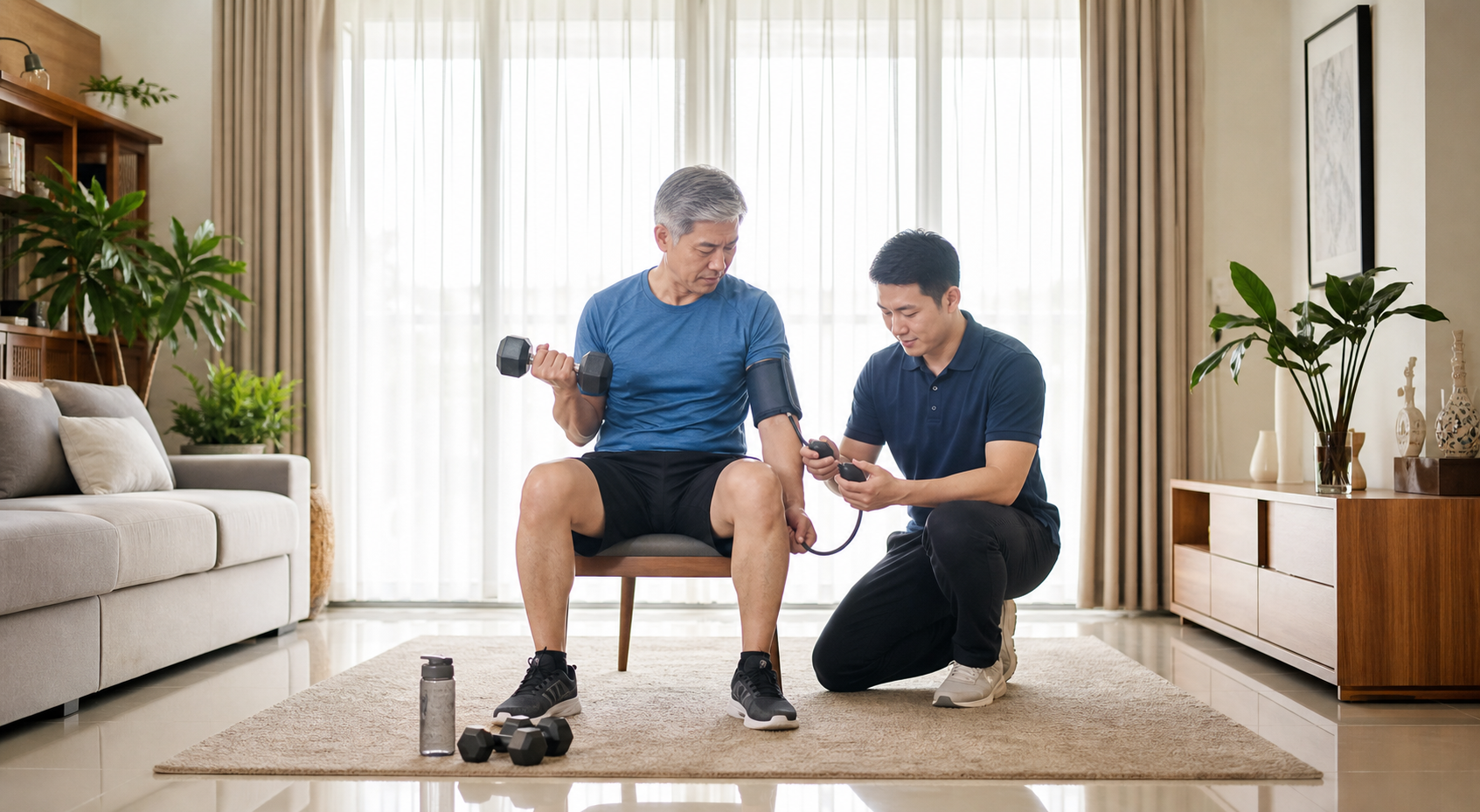
If you are still tired weeks after COVID or another long illness, start with pacing, not training. Do less than you think you can and keep a simple symptom log. Increase activity in small steps, and only if you feel steady the next day. If effort leaves you worse for a day or more, slow down and speak to your doctor.
Why do you feel so weak after an illness?
Two things usually overlap. One is deconditioning, the quick loss of muscle and fitness that follows days in bed. Older adults lose strength faster than they regain it, so a week of low activity can feel like a large setback. The other is the illness itself, which can leave fatigue, breathlessness and poor concentration long after the infection has cleared.
The WHO Delphi definition of post-COVID-19 condition (Soriano et al., 2022) describes symptoms that usually appear 3 months from onset, last at least 2 months and cannot be explained by another diagnosis. Fatigue, shortness of breath and cognitive difficulty are the common ones. The two can occur together but are managed differently, so the pattern of your symptoms matters.
How do you tell deconditioning from post-exertional malaise?
This is the key safety question, because the two need different plans.
| Feature | Deconditioning | Post-exertional malaise |
|---|---|---|
| Effort tolerance | Tired during activity, improves with regular practice | Feels fine, then crashes later |
| Timing of worst symptoms | Same day, settles after rest or sleep | Often 12 to 48 hours later (sometimes up to 72), lasting days |
| Response to gradual training | Gets better over 2 to 4 weeks | Worsens or plateaus |
| Other symptoms | Muscle weakness, breathlessness on stairs | Flu-like feeling, brain fog, unrefreshing sleep, racing heart |
NICE guidance on long-term effects of COVID-19 (NG188) states that careful self-pacing is an important part of self-management, and the expert panel noted there was not enough evidence to make specific exercise recommendations for people with ongoing symptoms. A 2024 best-practice proposal (Gloeckl et al.) advises screening for post-exertional malaise before starting any training and using a pacing approach if it is present. Both are reasons for caution, not for avoiding movement altogether.
Who should get checked before exercising?
See a doctor first if you have any of these after COVID or a long illness:
- Chest pain, tightness or pressure.
- Breathlessness at rest or out of proportion to effort.
- Palpitations, a resting heart rate that stays high, or fainting.
- Leg swelling or calf pain on one side.
- Oxygen saturation below your doctor’s advised level, if you measure it at home.
- Symptoms lasting beyond 4 weeks without improving.
Heart and lung complications can follow any severe infection. If you were hospitalised, read our guide on getting a parent walking after hospital, and see when to get medical clearance before exercise.
How do you pace your activity?
Pacing means spending your energy in planned portions so you do not crash. A practical version:
- Find your baseline. For one week, note what you do each day and how you feel the next morning. Pick a level that leaves you stable.
- Break tasks into short blocks. Walk 5 minutes, rest 5 minutes, repeat. Rest before you feel tired.
- Use the talk test. You should be able to speak in full sentences throughout.
- Change one thing at a time. Increase either time or intensity, by about 10 percent, only after 3 to 5 stable days.
- Plan rest after busy days. A wedding or a hospital visit uses up energy, so make the next day lighter.
A simple log works: date, activity, effort (0 to 10), fatigue next morning (0 to 10), sleep hours. If the next-morning score rises two points or more, drop back to the previous level.
What does a safe restart look like?
If you have no red flags and no crash pattern, use this staged plan. The doses are a common starting point in practice, not a trial-tested protocol. Move up only when you have 3 to 5 steady days at a stage.
| Stage | What to do | Dose |
|---|---|---|
| 1 | Short flat walks, seated leg lifts, seated arm raises | 5 to 10 minutes, once or twice daily |
| 2 | Longer walks, sit-to-stand from a chair, wall push-ups | 10 to 20 minutes walking, 1 set of 5 to 8 reps |
| 3 | Brisk walks, 2 sets of strength exercises on 2 days | 20 to 30 minutes, 2 sets of 8 to 10 reps |
| 4 | Return to previous routine, add gentle intensity | Follow the WHO target of 150 minutes moderate activity a week plus 2 days of strengthening |
The WHO 2020 guidelines (Bull et al.) recommend that older adults aim for at least 150 minutes of moderate activity per week and strengthening on two or more days, plus multicomponent balance work on three. That is the destination, not the starting point. Our guide to restarting exercise after a break and improving stamina after 50 can help with the later stages. You can track leg strength using the sit-to-stand test.
Stop and rest if you feel dizzy, develop chest discomfort, breathlessness that does not settle within a few minutes, or a racing heartbeat.
What changes in Malaysian conditions?
Heat and humidity add load on the heart, and dehydration worsens fatigue. Walk early in the morning or in an air-conditioned mall (see mall walking in the Klang Valley), and use exercising in Malaysia’s heat and humidity for timing. On hazy days, stay indoors; our note on exercise on hot and hazy days explains how. Sleep also drives recovery, so read exercise for better sleep.
Muscle rebuilding needs protein. A plate with fish, egg, tempeh or chicken at each meal is a reasonable start; see how much protein after 50.
When is a physiotherapist worth seeing?
Consider one if you are over 60, were hospitalised, have a crash pattern you cannot work out, or live with heart, lung or kidney disease. A physiotherapist can screen for post-exertional symptoms, set heart rate or effort limits and design a staged programme. See the hubs on exercise for chronic conditions and exercise for limited mobility for related pathways.
Key takeaways
- Start with pacing, then build. Do not push through fatigue that returns hard 1 to 2 days later.
- Post-exertional malaise needs a different, more cautious plan than simple deconditioning.
- Chest pain, fainting, palpitations or breathlessness at rest need a doctor before exercise.
- Increase time or effort by about 10 percent only after several steady days.
- Use cooler hours, hydration and protein to support recovery in Malaysia.