Five progressive balance exercises older adults can start at home to cut fall risk, with timings, safety rules and red flags from a physiotherapist.
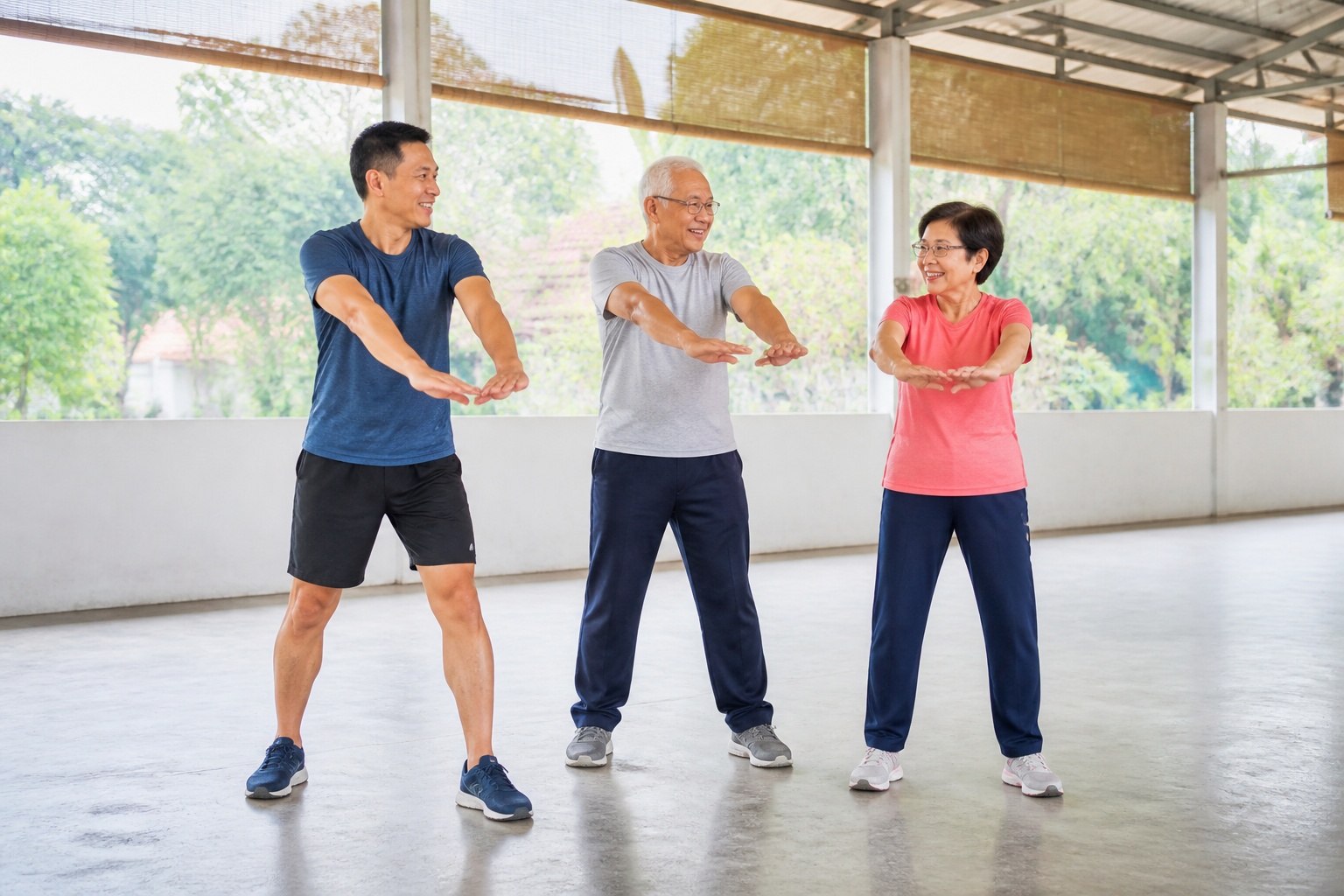
Five exercises will build most of the balance you need to reduce your fall risk: feet-together stand, tandem stance, single-leg stand, sit-to-stand and heel-to-toe walking. Done daily beside a sturdy counter and made gradually harder, they improve steadiness within weeks. A Cochrane review of 108 trials found exercise reduced the rate of falls in community-dwelling older adults by about 23 percent.
Falls are common. WHO estimates that 28 to 35 percent of people aged 65 and over fall each year. In Malaysia, the 2018 national survey found that about 14 percent of people aged 60 and over reported a fall in the previous 12 months. Most falls are not freak accidents. They reflect weak legs, slower reactions and poor balance, all of which respond to training.
Safety rules before you start
- Work beside a kitchen counter or a heavy, stable chair you can grab.
- Wear closed shoes with grip, or go barefoot on a dry, non-slip surface. Avoid smooth socks on tiles.
- Clear the floor of loose mats and cables, and have your phone within reach.
- Progress only when the current step is steady for the full time.
- Stop if you feel dizzy, have chest discomfort or become unusually breathless, and seek medical advice.
If you have fallen in the past year, are on several medicines, have dizziness on standing, a neurological condition, or a fear of falling that limits you, get a physiotherapy assessment first. You can check where you stand with our fall risk check.
1. Feet-together stand
Stand with your feet touching, hands hovering over the counter, and hold for 30 seconds. Repeat 2 to 3 times. When this is easy, try it with your eyes closed for 10 seconds, with the counter close by. Closing your eyes removes vision, which makes your inner ear and feet work harder.
2. Tandem stance
Place one foot directly in front of the other, heel touching toes, and hold 20 to 30 seconds. Switch the leading foot. Keep a hand near the counter. This narrows your base and is a much harder test than it looks.
3. Single-leg stand
Lift one foot slightly off the floor and hold, one hand on the counter. Begin with 5 to 10 seconds and build towards 30 seconds each leg, 2 to 3 times. See how to do a single-leg stand for progressions and a self-test. Being unable to hold this for a few seconds is a useful warning sign, covered in the single-leg balance test.
4. Sit-to-stand
Sit on a stable chair with arms crossed. Stand up fully, then sit back with control over 3 seconds. Do 2 sets of 8 to 10. If you must push with your hands, use them lightly and aim to reduce that over time. This builds the leg strength that underpins balance. It bridges balance with strength training, and the sit-to-stand test lets you track progress.
5. Heel-to-toe walk
Walk in a straight line, placing the heel of the front foot against the toes of the back foot, with a wall or counter alongside. Take 10 steps, turn, and return, twice. Look ahead, not at your feet. Our guide to the heel-to-toe walk has variations.
A simple progression table
| Stage | What to do | Move up when |
|---|---|---|
| Week 1 to 2 | Feet together 30 s, tandem 20 s, single-leg 5 s, hand on counter | You can finish each hold without gripping the counter |
| Week 3 to 4 | Single-leg 15 to 20 s, sit-to-stand 2 x 10, heel-to-toe 2 x 10 steps | Holds feel steady and calm |
| Week 5 to 8 | Single-leg 30 s, eyes closed feet-together 10 s, add a head turn while walking | You rarely need to touch support |
| Week 9 and beyond | Dual-task: count backwards or carry a light bag while doing the holds | You wish to challenge reactions |
The principle of making balance tasks gradually less supported is central to the evidence. A 2017 meta-analysis found that exercise programmes that challenged balance and were done for more than about three hours a week had larger effects on falls. You do not need to start there. Build towards it with daily short sessions plus a weekly strength routine.
How balance fits with the rest of your week
Balance practice works best alongside leg strength, a walking habit and a safe home. Add calf raises, step-ups and brisk walking. Check your home for hazards using reducing fall risk at home. Tai chi is a good group option too, covered in tai chi for older Malaysians.
The World Falls Guidelines (2022) recommend that older adults at increased risk of falling get a multifactorial assessment covering medicines, vision, blood pressure, footwear, strength and home hazards, in addition to exercise.
When to see a professional
See a doctor or physiotherapist promptly if you have:
- a fall with head strike, especially if you take blood thinners;
- new dizziness, blackouts, weakness on one side or sudden unsteadiness;
- numb feet or a diabetic foot problem;
- repeated near-falls, or a growing fear of walking.
Common mistakes
- Gripping the counter with both hands. Use fingertips only when you can, so the balance system does the work. Let go gradually.
- Rushing the progression. If you wobble hard or cannot hold the time, go back a step. Quality matters more than speed.
- Looking down. Fix your eyes on a point at eye level. Looking at your feet makes balance harder.
- Skipping the weak side. Most people have a stronger leg. Do the same hold on both sides, starting with the weaker one.
- Training only balance. Without leg strength the effect is smaller. Add sit-to-stands and calf raises.
Build it into daily life
Short, frequent practice works well. Stand on one leg while the kettle boils or while you brush your teeth, holding the sink. Do sit-to-stands during TV ad breaks. Walk heel-to-toe along the corridor to the bathroom. Ten small sessions of 30 seconds is a good day’s work. Link the habit to something you already do, such as after your morning tea.
How to tell if you are improving
Retest every two to four weeks under the same conditions: same time of day, same shoes, same counter. Note how long you can hold a single-leg stand on each side, how many sit-to-stands you can do in 30 seconds, and how steady the heel-to-toe walk feels. You should see small, steady gains. If your scores fall, you feel less steady, or you notice new dizziness, do not push on. Rest, review your medicines and sleep, and speak to a doctor or physiotherapist if it persists. Falls risk can change quickly with illness, dehydration or a new medicine.
Key takeaways
- Five exercises cover most needs: feet-together, tandem, single-leg, sit-to-stand and heel-to-toe walking.
- Daily practice of 5 to 10 minutes beside a sturdy counter beats occasional long sessions.
- Make each exercise harder gradually: less hand support, narrower stance, eyes closed, then dual-tasking.
- Pair balance work with leg strength and home safety changes for the best effect on falls.
- Get assessed first if you have fallen recently, feel dizzy or have a neurological condition.
For older adults who would feel safer starting with a professional, we deliver this through our home programme for ageing parents, coached against your own stairs and rooms across the Klang Valley.