Training for what your body can do keeps you motivated and independent. How to set functional goals, with measurable examples, benchmarks and weekly plans.
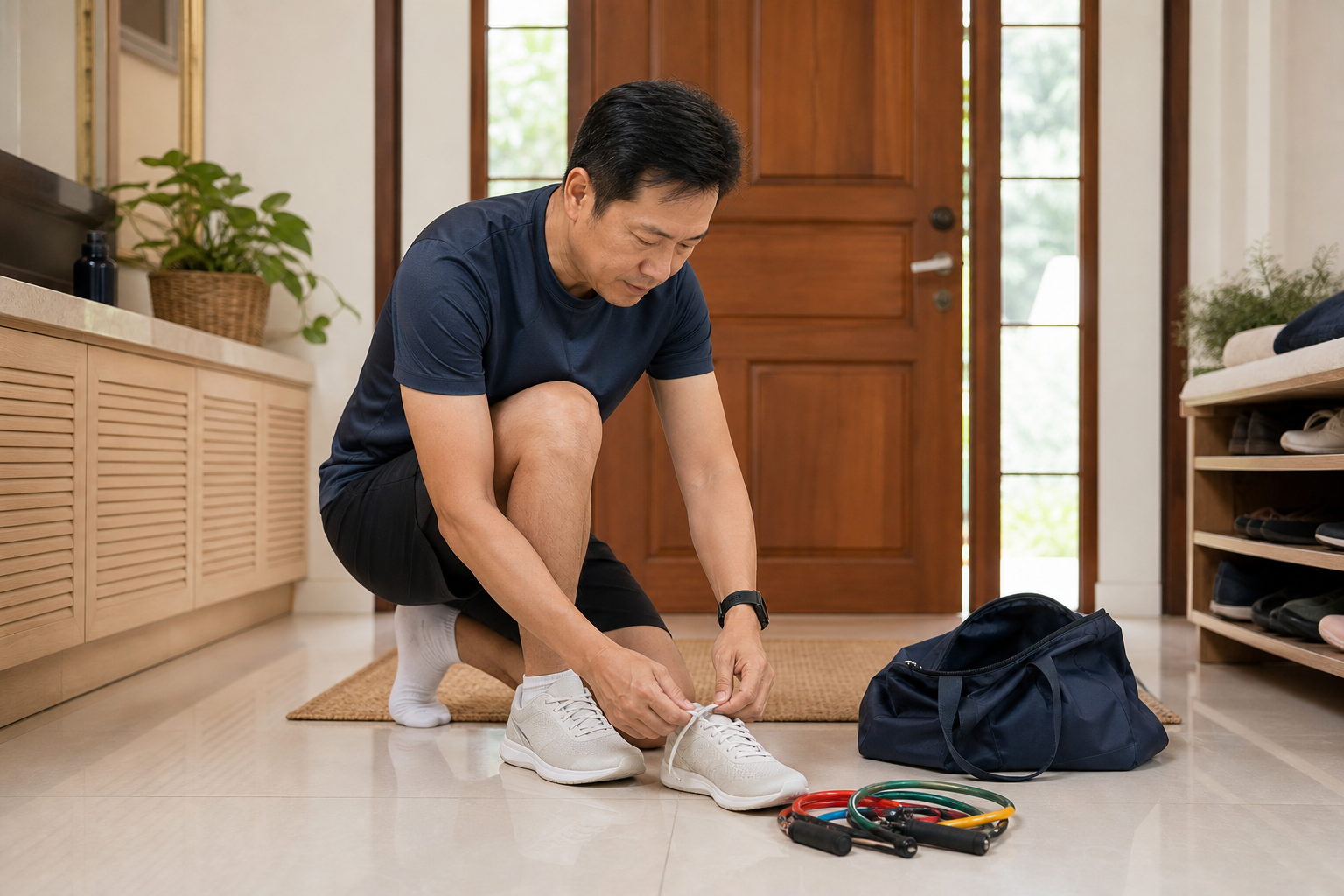
Set goals around what your body can do, not just how it looks. A functional goal, such as getting up from the floor without using your hands or climbing three flights of stairs without stopping, is specific, measurable and tied to the independent life you want. Appearance changes often follow, but your motivation no longer depends on the scale.
Why appearance goals often fail
Goals such as “lose 10 kg” or “get a flat stomach” are not wrong, but they make a fragile base for a routine:
- Slow feedback. Visible change takes weeks, and the scale fluctuates with water, salt and the time of day.
- Weak link to health. You can lose weight by dieting hard and losing muscle, which is the opposite of what you want as you age. See why the scale lies after 40.
- No natural endpoint. Once the number is reached, or missed, the reason to train disappears.
Motivation research supports a different approach. A systematic review of exercise and self-determination theory found that people who exercise for enjoyment, a sense of competence and personally valued outcomes tend to stay with it longer than people driven mainly by appearance or pressure from others. Functional goals sit squarely in that first group.
What makes a functional goal work
Goal-setting research (Locke and Latham) shows that specific, challenging, measurable goals lead to better performance than vague “do your best” goals, especially when you get feedback on progress.
A good functional goal is:
- Specific: “Climb 3 flights of stairs” rather than “be fitter”.
- Measurable: you can count, time or distance it.
- Personal: it ties to something you care about, such as a grandchild, a trip or a hobby.
- Dated: with a review in 8 to 12 weeks.
- Slightly hard: a stretch, but realistic.
Examples, with how to measure them
| Everyday goal | Measure | Benchmark |
|---|---|---|
| Stand from chairs and toilets easily | 30-second sit-to-stand | 12 to 17 stands for women, 14 to 19 for men aged 60 to 64 |
| Keep a good walking pace | 4-metre usual walking speed | 1.0 m/s or faster is reassuring; under 0.8 m/s is a warning sign |
| Open jars, carry shopping | Grip strength | Low strength is below about 27 kg for men and 16 kg for women (European) or 28 kg and 18 kg (Asian) |
| Get up from the floor | Sitting-rising test | Aim to rise without hands, with 10 the top score |
| Climb stairs | Flights climbed without a pause | Increase by one flight at a time |
| Walk further | Minutes or km at a steady pace | Build from 20 to 30 and then 60 minutes |
The grip cut-offs come from the European (EWGSOP2) and Asian (AWGS 2019) sarcopenia consensus statements. The AWGS values are designed for Asian populations, so they are a better reference for most Malaysians. Our guides to the sit-to-stand test, gait speed and grip strength explain how to measure each. You can also test several at once in fitness tests you can do at home.
Why the floor test is worth knowing
In the sitting-rising test, you lower yourself to the floor and stand up again, losing a point each time you use a hand, knee or other support. In a study of 2,002 adults aged 51 to 80, people with lower scores had a higher risk of death over about six years than those with top scores. The test is a marker, not a cause, but it captures strength, balance, mobility and body weight in one move. If you cannot yet do it, how to get up from the floor is a safe way to practise.
Turn a goal into a weekly plan
Take “get up from the floor without hands” as an example:
- Baseline: note how you currently do it, with hands, knees or a chair.
- Train the parts: squats or sit-to-stands, glute bridges and single-leg stands, two or three days a week.
- Practise the skill: 3 to 5 floor transfers twice a week, next to a sturdy chair.
- Review at 8 to 12 weeks: test again and set the next step.
The same structure works for any goal. A Cochrane review found that progressive resistance training in older adults improves muscle strength and physical function, so strength work is the common engine behind most functional goals. See strength training for longevity.
The side effect: you also change how you look
Training for strength, power and fitness builds muscle and reduces harmful fat, which often improves how you look as a by-product. The key difference is that your routine does not depend on it. A functional approach also fits Malaysian life: getting off the floor at kenduri and family gatherings, climbing LRT and MRT stairs, carrying bags from the pasar, squatting comfortably, or keeping up on a holiday walk.
Keep it going
Pair goals with habit systems. Our guides to building an exercise habit and staying consistent when life gets busy cover cues and restarts. The longevity mindset page explains the wider approach.
Safety note: do not test floor transfers, hangs or fast walking if you have significant balance problems, pain, dizziness or heart symptoms, and check with your doctor or physiotherapist first.
Examples of weekly actions behind a goal
| Goal | Weekly actions | Review |
|---|---|---|
| Climb 3 flights without stopping | 2 strength days with step-ups, stair practice twice a week, one brisk walk | Count flights every 4 weeks |
| Carry shopping in one trip | 2 carry sessions, row and hinge work | Weigh the bags you carry |
| Walk 5 km at a steady pace | 3 walks, adding 5 minutes each week | Time the loop every 4 weeks |
| Stand from a low sofa without hands | Sit-to-stands from lower seats, glute bridges | 30-second chair stand every 8 weeks |
| Play on the floor with grandchildren | Floor transfers 3 to 5 times, twice a week | Sitting-rising test every 8 weeks |
When a goal is not realistic yet
If you have a medical condition, pain or have been inactive for years, a goal may need to be staged. Make the first target smaller, such as “stand from a chair without hands five times”, and increase as your strength builds. A goal that is too large creates the same discouragement as an appearance goal that is too distant. A physiotherapist can help you break goals into steps that match your health, and our conditions guides explain how exercise adapts to common diagnoses.
Key takeaways
- Functional goals describe what you want to be able to do, so they are specific, measurable and meaningful.
- Appearance goals are fragile because feedback is slow and does not reflect health.
- Use simple tests, such as sit-to-stand, walking speed, grip and floor rising, to turn a goal into a number.
- Set a date, plan weekly training, and retest every 8 to 12 weeks.
- Strength training underpins most functional goals, and appearance changes often follow.
If you would like help setting functional goals and building a plan to reach them, we run home-visit assessments across KL and Selangor.