Feel too unfit, too old or too self-conscious to start? A gentle 4-week plan to build exercise confidence after 40, at home and without needing a gym.
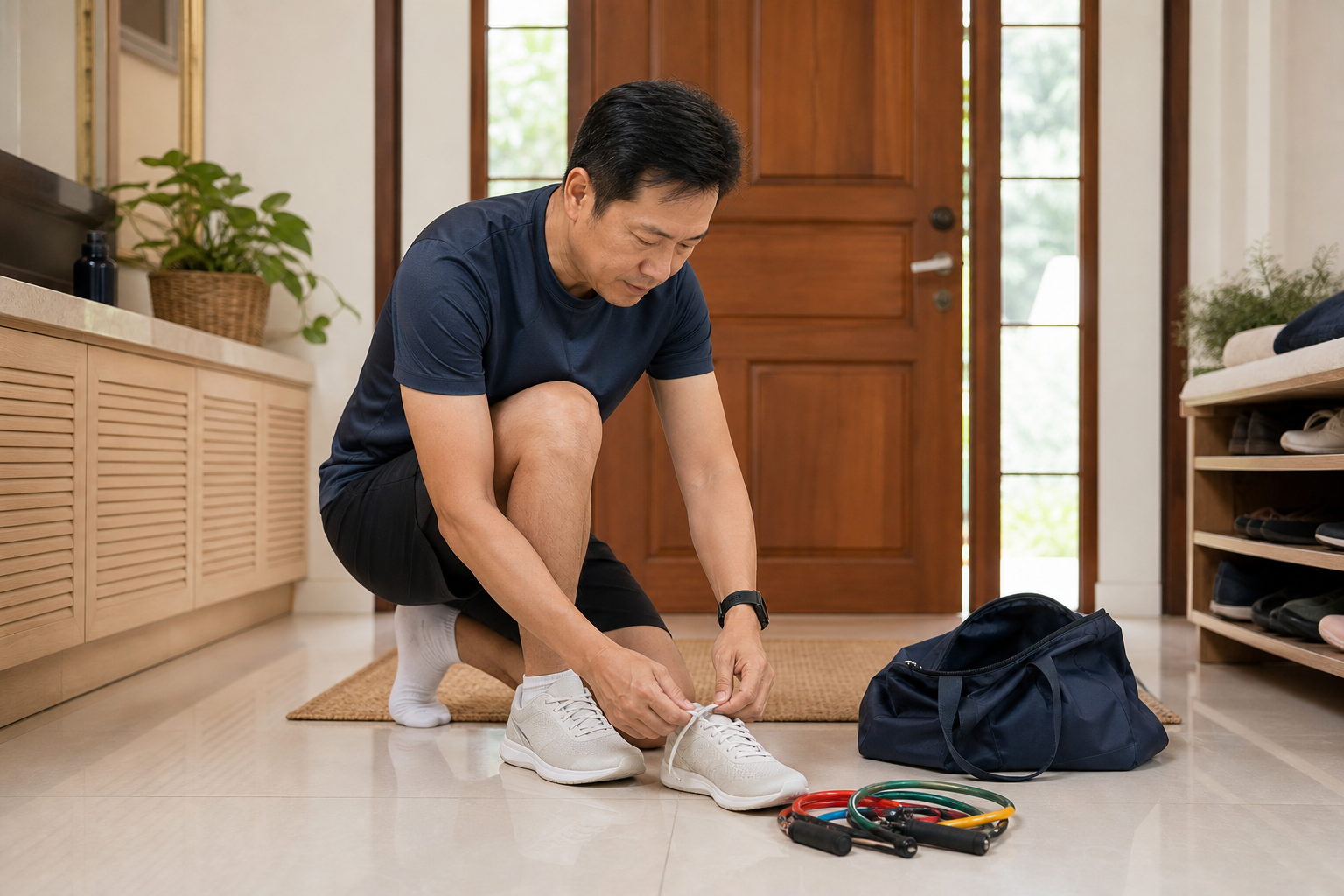
You build exercise confidence by doing small, private, repeatable sessions until you have proof that you can. Do not wait to feel ready. Start with 10 minutes, three days a week, at home or in your neighbourhood, and let completed sessions, not mood, be your measure.
Why confidence drops after 40, and why it returns
Many people stop exercising for a few years because of work, children, injury or illness. When they try to restart, three things get in the way:
- A mismatch with your old self. You remember what you could do at 25, and today’s version feels like failure.
- Fear of being watched. Gyms, group classes and even parks can feel like places where everyone else knows what they are doing.
- Fear of injury. A past back or knee problem makes every new movement feel risky.
Psychologists call the belief that you can do a specific task self-efficacy, and its strongest source is personal success, known as a mastery experience. That is good news, because success can be designed. If the task is small enough, you succeed, and the next one feels possible.
The research on motivation backs this up. In a systematic review of exercise and self-determination theory, people who felt competent, had choice over what they did and enjoyed it were far more likely to keep going.
Start where no one is watching
Your first four weeks do not need a gym.
| Week | Aim | Example |
|---|---|---|
| 1 | Show up 3 times | 10-minute walk around the neighbourhood, after dinner or early morning |
| 2 | Show up 3 to 4 times | 15-minute walk, plus 1 set of 8 sit-to-stands and 8 wall push-ups |
| 3 | Add structure | 20-minute walk, plus 2 sets of the same exercises and a hip bridge |
| 4 | Test and celebrate | Re-measure walking time and sit-to-stand count, and record the change |
The exercises are explained in our beginner strength guide and no-equipment home workout. If you have been away from exercise for a long time, see how to restart after a break.
Choose the cooler hours for walking, early morning or after sunset, so the heat does not become another reason to quit. See exercising in Malaysia’s heat and humidity.
Make progress visible
Feelings of fitness lag behind real changes. Write down a few numbers in a notebook or phone:
- Walking time or distance for the same loop.
- Sit-to-stands in 30 seconds. See the sit-to-stand test.
- How many stairs you can climb before you need a pause.
- Your usual energy level on a 1 to 10 scale.
After 4 weeks, these numbers become evidence. Habit research found that new behaviours took a median of about two months to feel automatic, and that missing a single day made little difference. So expect to feel awkward for a while and do not read that as failure.
Strength training is safe and effective at any age
A Cochrane review of progressive resistance training in older adults found improvements in muscle strength and physical function, and the NSCA position statement supports resistance training for older adults with appropriate supervision and progression. The first gains come quickly, partly because your nervous system learns to use muscles better. You will often notice that stairs, carrying shopping and getting out of a chair feel easier before your body shape changes.
The WHO guidelines recommend muscle-strengthening on at least two days a week for all adults, and the benefits begin at low volumes.
If you want to go to a gym
When you are ready, make it easy:
- Visit at off-peak times. Mid-morning on weekdays is usually quiet.
- Take the induction. Ask staff to show you the machines and how to adjust them. That is what they are there for.
- Have a written plan. Four or five exercises, 2 sets each, so you never stand wondering what to do.
- Machines are fine. They are stable and easy to learn for beginners.
- Ignore the mirror and the person next to you. Most people are focused on themselves.
Reframe comparison and comments
Compare yourself to last month’s you. Relatives in Malaysia can be blunt about weight and fitness, and that can make exercise feel loaded. Keep your goal about function: walking further, climbing stairs, playing with grandchildren. See functional goals, not vanity goals and the longevity mindset.
When to check with a doctor first
Speak to your doctor before starting if you have any of these:
- Chest pain, pressure or breathlessness on mild effort.
- Dizziness or fainting.
- A heart condition, uncontrolled high blood pressure, diabetes with complications, or recent surgery.
- Joint pain that is getting worse, or numbness and weakness in a limb.
Stop exercising and get help for chest pain, severe breathlessness, faintness or sudden weakness. See when to get medical clearance.
Common worries and straight answers
| Worry | Answer |
|---|---|
| ”I will hurt myself.” | Injury risk is low when you start gently and build slowly. Choose pain-free movements, and get a physiotherapist’s advice if you have a past injury |
| ”I am too heavy to exercise.” | Walking, cycling, swimming and chair-based strength work are all suitable. Start with low impact and short sessions |
| ”I tried before and quit.” | Most people do. Last time may have been too much, too soon. Start with a smaller dose and fixed cues |
| ”I have no time.” | Ten minutes counts. See exercise snacks for desk workers and the 30-minute longevity workout |
| ”Everyone at the gym is fitter.” | Most people are absorbed in their own session, and many started where you are |
| ”My back or knees hurt.” | Pain needs sensible modification, not total rest. See exercise for chronic back pain and knee pain and keeping active |
What your first gym or class visit can look like
If you decide to go, a simple script makes it easier. Call ahead and ask for a quiet time. Tell the staff, “I am new and would like a walkthrough of three or four machines.” Bring a written plan, a towel and water bottle, and wear shoes you can walk in. Plan to stay 30 minutes, do two sets of each exercise, and leave while you still feel good. Success on the first day means you came and finished, not that you lifted heavy.
Celebrate the right things
Confidence grows when you notice real wins. Keep a short list of “firsts”: the first week of three sessions completed, first 20-minute walk, first time you took the stairs without holding the rail, first 10 sit-to-stands. Share one with a friend or family member each week. If you slip, record the restart as a win too. Over a few months, that list becomes the evidence you were waiting for.
Key takeaways
- Confidence follows action: start small, repeat often, and let completed sessions build proof.
- Begin at home or outdoors with 10 minutes, three days a week, and add one element each week.
- Track simple measures like walking time and sit-to-stands to make progress visible.
- Strength training is effective at any age and improves everyday function quickly.
- Check with your doctor first if you have heart symptoms, dizziness or a significant condition.
If you would like gentle, judgement-free coaching to get started, we run home-visit assessments across KL and Selangor, in the comfort of your own home.