Habits take about two months to form, not 21 days. How to start small, anchor exercise to your day and restart after a miss, with a Malaysian slant.
A habit takes longer than most people expect: in one well-known study, the median time for a new daily behaviour to feel automatic was 66 days, and individuals ranged from 18 to 254 days. So the way to build an exercise habit is to make the behaviour small, tie it to something you already do, remove friction, and plan how you will restart after a miss. Willpower is the weakest part of the plan.
Why do most people stop exercising?
Most people do not lack knowledge. They lack a system that survives a busy week, Hari Raya, a work deadline, a bout of illness or a few days of haze. January plans usually fail for the same reasons:
- The plan was too big (five sessions a week from a standing start).
- It relied on motivation, which comes and goes.
- It had no fixed time or place.
- One missed week turned into three months.
The people who still exercise at 70 usually did not have more discipline. They set things up so that exercise happened with little negotiation.
How long does a habit really take?
The often-quoted 21 days has no good evidence behind it. In the 2010 study by Lally and colleagues, 96 volunteers chose a new daily behaviour, such as drinking water at lunch or doing a 15-minute run before dinner, and rated how automatic it felt over 12 weeks. The median time to plateau in automaticity was 66 days. Exercise-type habits tended to take longer than simple ones like drinking a glass of water. Missing a single day did not meaningfully harm the process.
The practical lesson: plan for two to three months of deliberate effort, and expect it to feel easier from about week 8 to 10.
Step 1: Start smaller than feels necessary
A 20-minute session you will do beats a 90-minute plan you will dread. For someone who is currently inactive:
- Week 1 to 2: a 10 to 15 minute walk, or three bodyweight exercises, on three set days.
- Week 3 to 4: 20 to 30 minutes, adding a wall push-up and squat circuit.
- Week 5 to 8: build towards two strength sessions and 150 minutes of walking per week, in line with WHO guidance.
Set a minimum version, for example 5 minutes, that counts as a “win” on bad days. Often you will carry on once you start.
Step 2: Anchor it to something you already do
Attach the exercise to a reliable trigger, using a plain sentence: “After I make my morning kopi, I do 10 minutes of mobility.” Or “When I get home and take off my shoes, I walk around the block.” A fixed cue removes the daily decision.
Good anchors in Malaysian life include:
- After Subuh prayer or after the morning azan.
- Before the morning shower.
- After dropping the children at school.
- After lunch, before returning to your desk (a brisk 10 minutes in the mall corridor counts).
- When you get home, before the evening meal.
Step 3: Reduce friction
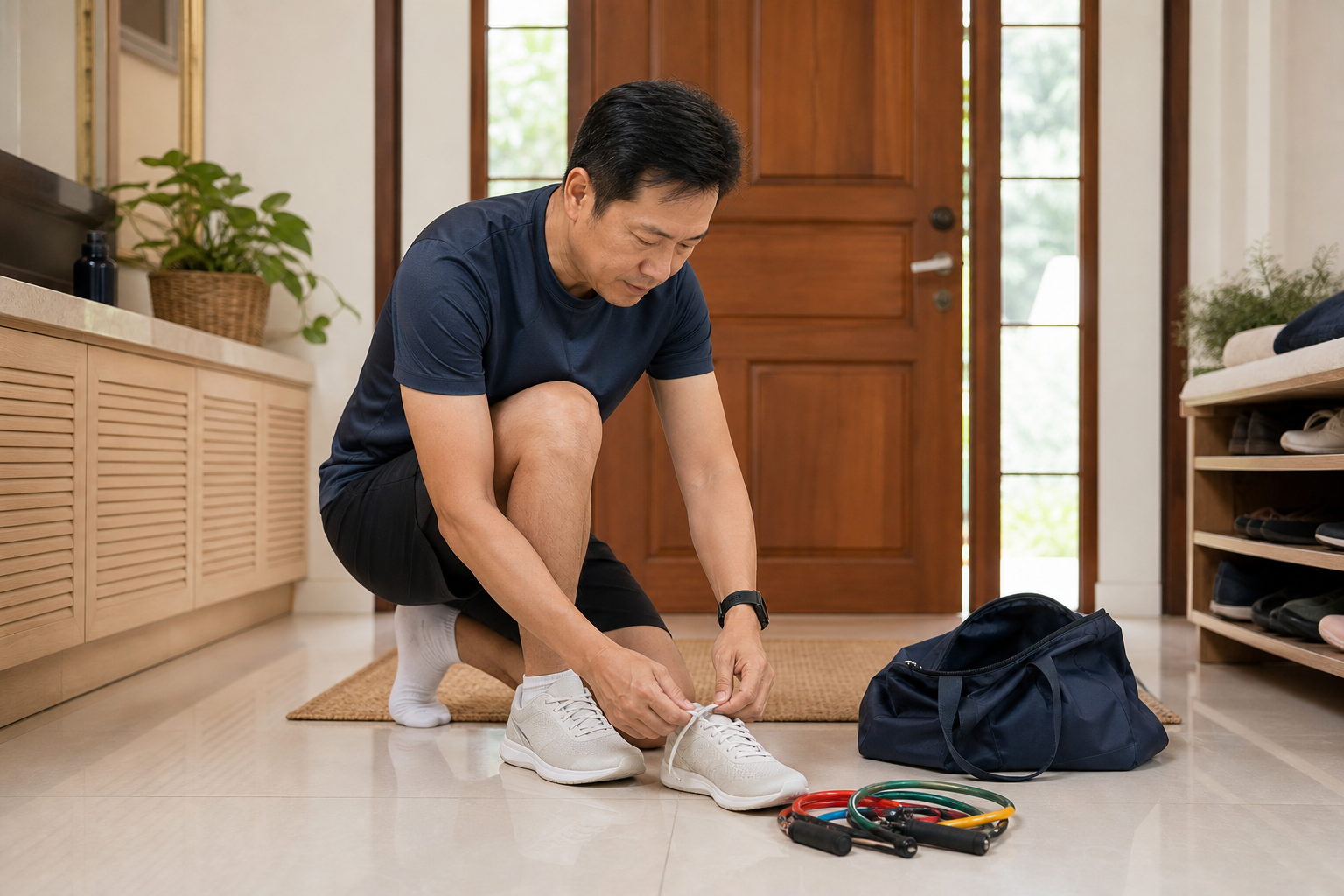
Everything between you and the first rep is a chance to skip it. Lay out your shoes and a resistance band the night before. Keep a pair of dumbbells or a band in the living room. Choose a place close to home. In the heat, early morning or covered, air-conditioned options such as mall walking remove the weather as an excuse. See home-based training for a no-gym set-up.
Step 4: Track lightly
A tick on a calendar or a note in your phone turns effort into something you can see. Re-test a few simple measures every 12 weeks, such as the sit-to-stand test or a walking distance, so that progress comes from your own numbers and not from how you feel on a given Tuesday. Our methodology uses exactly this loop.
Step 5: Plan for the miss
You will miss sessions through travel, illness, family events, the festive season or haze. Decide in advance what you will do:
- Never miss twice. If you skip one day, the next day gets a session, however short.
- Have a wet-weather and haze plan. A 15-minute indoor routine, such as the home workout with no equipment.
- After a longer break, restart at about half your previous load for a week; see how to restart exercise after a break.
The goal is not a perfect streak. It is a short gap every time.
Make the reason personal
Habits that last are usually connected to something that matters: being able to play on the floor with grandchildren, travel without needing help with luggage, or keep your independence. Write your reason down. Function-based goals tend to hold longer than appearance goals; see functional goals, not vanity.
When to check with a doctor first
If you are inactive and aged 40 or over, or you have heart disease, diabetes, high blood pressure or other conditions, speak to your doctor before ramping up intensity. Chest pain, unusual breathlessness, dizziness or fainting during exercise mean stop and get medical advice. Our guide on when to get medical clearance lists the red flags.
Key takeaways
- Expect about two months, not three weeks, for exercise to feel automatic, with wide individual variation.
- Start with a minimum session you can do on your worst day, then build.
- Attach exercise to an existing routine such as kopi, Subuh or the school run, and lower friction at home.
- Track lightly, and aim never to miss twice in a row.
- Build towards WHO targets of 150 to 300 minutes of moderate activity and two or more strength days per week.
If you would like help turning intention into a routine that fits your life, we coach this across KL and Selangor through home-visit assessments.