The wall sit builds thigh strength without equipment. Step-by-step form, hold times, easier and harder versions, and safety tips for adults 40+.
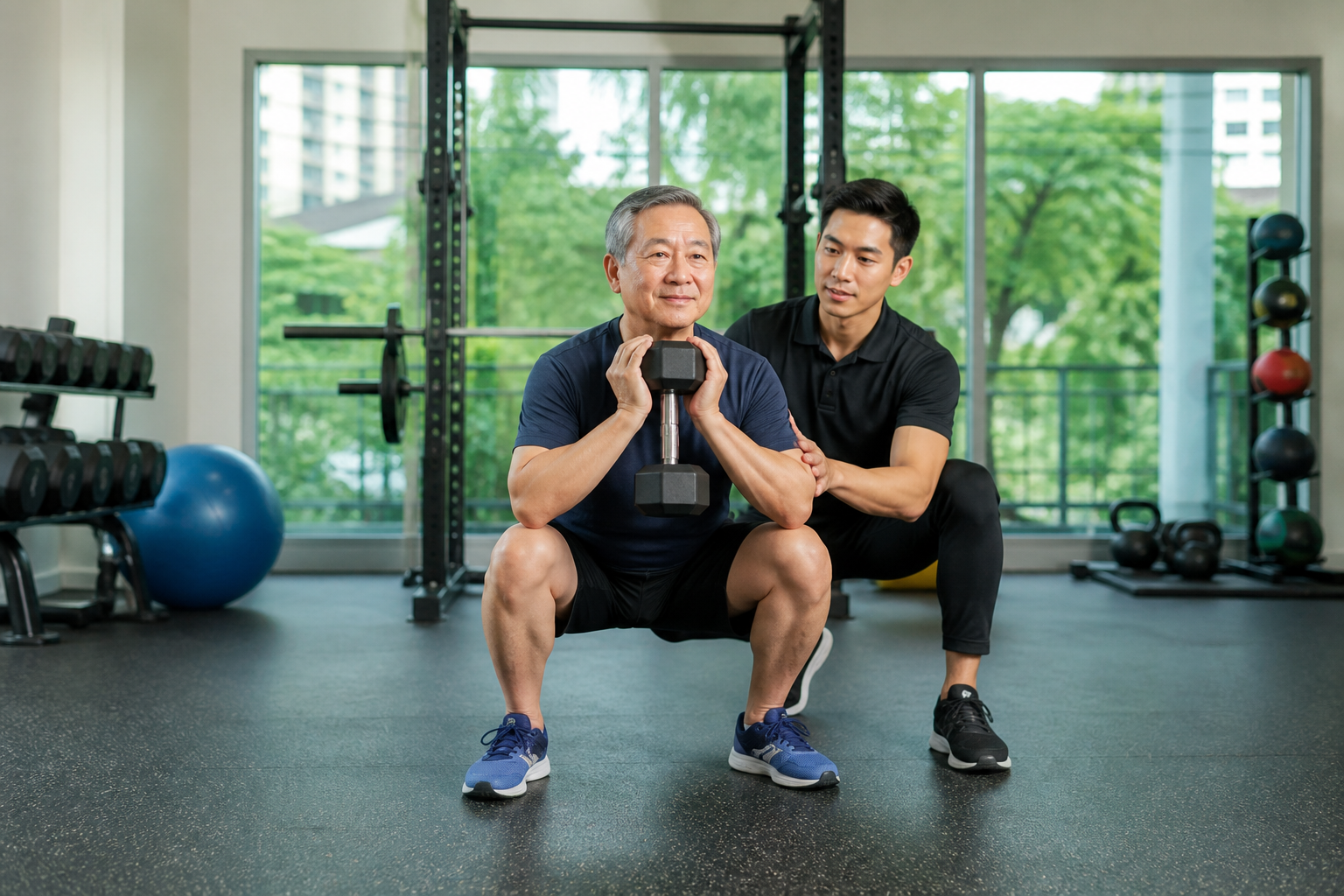
A wall sit is an isometric exercise where you slide your back down a wall into a seated position and hold it. It builds endurance in the thigh muscles without any equipment, and it is easy to scale. Most adults over 40 can start with 3 holds of 15 to 20 seconds and build toward 45 to 60 seconds.
Why do wall sits suit adults over 40?
Leg strength decides how easily you get out of a chair, climb stairs and walk at a decent pace. The wall sit trains the quadriceps and glutes while the wall supports your back, so the balance demand is low. It needs no gym, mat or partner, which suits a flat or condo.
Isometric exercise also has research behind it for blood pressure. A 2023 network meta-analysis of 270 randomised trials found that isometric training gave the largest average reductions in resting blood pressure, with wall squats ranking best for systolic pressure. This is an average across trials, not a promise for any one person. If you have hypertension, follow your doctor’s treatment and the Ministry of Health hypertension guidelines, and read our guide to exercise for high blood pressure.
How do you set up?
- A flat wall with no skirting board in the way, or a wall with a smooth surface.
- Non-slip shoes or bare feet on a non-slip floor. Tiles in Malaysian homes can be slippery with sweat or humidity, so use a mat or wear grip socks.
- A timer or clock.
- A sturdy chair nearby to sit on after.
How do you do a wall sit step by step?
- Stand with your back against the wall and feet about shoulder-width apart, roughly 50 to 60 cm from the wall.
- Slide down slowly until your knees are bent. Start with a shallow angle, around 120 degrees at the knees, not a full 90.
- Keep your knees over your ankles, not past your toes, and in line with your second toe.
- Press your lower back and shoulders against the wall. Rest your hands on your thighs or let them hang by your sides.
- Breathe steadily. Count the seconds out loud if you need to remember to breathe.
- Hold for the planned time, then press through your heels and slide back up.
Rest for 1 to 2 minutes between holds.
What mistakes are common?
| Mistake | Fix |
|---|---|
| Holding the breath | Count out loud or breathe in for 3, out for 3 |
| Feet too close to the wall | Move the feet further out so knees stay over ankles |
| Knees falling inward | Press the knees gently out toward the little toes |
| Pushing hands on the thighs hard | Let hands rest lightly or hang |
| Going too deep too soon | Use a shallow angle first |
| Ignoring discomfort | A burning thigh is normal; sharp knee pain is not |
What are easier and harder versions?
Easier
- Slide down only a quarter of the way (a small knee bend).
- Hold for 10 seconds, with a rest between holds.
- Use the back of a chair for support, or a stability ball behind your back.
- Try sit-to-stand progressions if holding feels too much.
Harder
- Slide down to a 90-degree angle.
- Hold for 60 seconds or longer.
- Hold a light weight on your lap, or press a small ball between the knees.
- Lift one foot a few centimetres for 5 seconds at a time, only if stable.
- Move on to squats and step-downs.
What sets, reps and hold times work for adults 40 and over?
| Level | Hold | Holds per session | Rest | Frequency |
|---|---|---|---|---|
| Beginner | 10 to 20 sec | 3 | 60 to 90 sec | 2 days a week |
| Intermediate | 30 to 45 sec | 3 to 4 | 60 to 90 sec | 2 to 3 days a week |
| Advanced | 45 to 60+ sec | 3 to 4 | 90 to 120 sec | 2 to 3 days a week |
Progress by adding 5 seconds every week or two, or by lowering the angle slightly. For a structured plan, use progressive overload for older adults.
The WHO recommends that adults do muscle-strengthening activities on at least 2 days a week, and wall sits count toward this.
Who should check with a doctor first?
See your doctor before you start if you:
- have high blood pressure that is not controlled or you are not sure about your readings;
- have heart disease, heart failure or have had a recent cardiac event (see exercise with heart failure);
- have knee osteoarthritis or knee pain that worsens with bending (knee pain and keeping active);
- have had recent knee, hip or back surgery;
- have dizziness, fainting or an eye condition such as proliferative retinopathy.
Stop immediately if you feel chest pain, severe breathlessness, light-headedness, sharp knee pain or pain that stays after you stop. Never hold your breath. Isometric contractions raise blood pressure while you hold, and breath-holding raises it further.
When and where should you do wall sits in Malaysia?
An air-conditioned room or a fan makes a difference. In hot weather, exercise early, drink water before and after, and avoid wall sits straight after a heavy meal. Our heat and humidity guide has more tips. On hazy days, stay indoors; see indoor exercise for hot and hazy days.
For more leg and strength exercises, see strength training for longevity and the exercise library.
Key takeaways
- A wall sit is a no-equipment isometric exercise that builds thigh endurance.
- Start with a shallow angle and 3 holds of 10 to 20 seconds, then build slowly toward 45 to 60 seconds.
- Breathe throughout and keep knees over ankles.
- Isometric training shows average blood pressure benefits in trials, but check with your doctor if your blood pressure is uncontrolled.
- Stop for chest pain, dizziness or sharp knee pain.