What is known about fitness in Malaysian adults: NHMS activity data, grip-strength studies, older-adult cut-offs, and the data gaps.
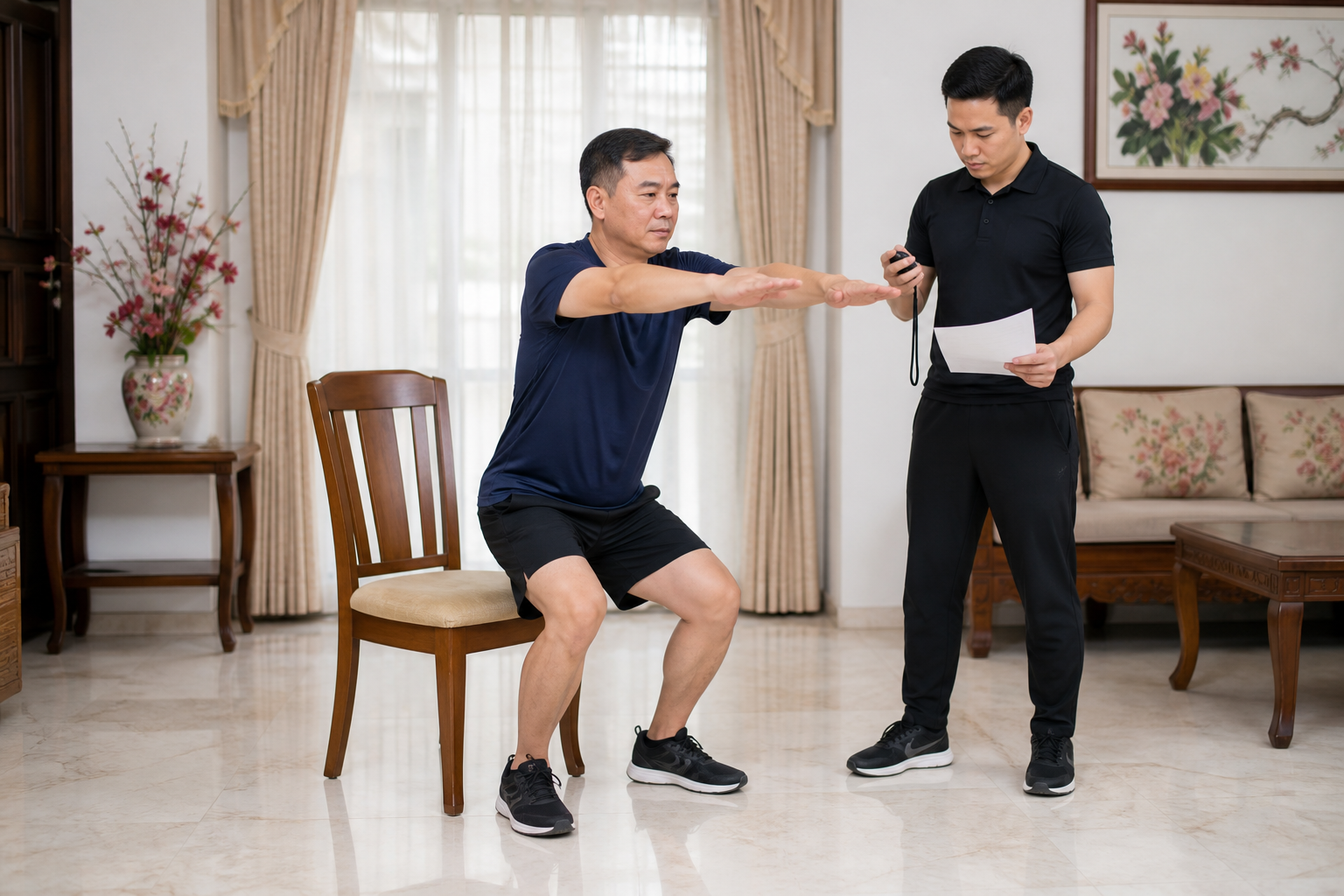
There is no single national table of fitness norms by age for Malaysian adults. What exists are national surveys of physical activity (NHMS), some regional studies of handgrip strength, and cohort studies of older adults that set screening cut-offs for function. This article lays out those figures, with their sources, and says plainly where data are missing.
Treat every number below as a population average from a specific study, not a pass mark. For personal tracking, our guides to fitness tests you can do at home and the functional age tool are more useful than any single comparison.
What do we know about physical activity in Malaysia?
The National Health and Morbidity Survey (NHMS), run by the Institute for Public Health, Ministry of Health Malaysia, is the main national source. It measures how active people say they are, not how fit they are.
| NHMS 2019 finding | Figure |
|---|---|
| Adults aged 18 and above who were physically inactive | 24.6% (95% CI 23.2 to 26.1) |
| Same measure in NHMS 2015 | 33.5% |
| Inactivity among women | 28.2% |
| Sample interviewed | 10,356 of 10,472 selected respondents |
| Tool | Short IPAQ (self-report) |
| Urban versus rural | Inactivity higher in urban populations |
Two cautions apply. First, “inactive” is defined by a questionnaire threshold, not by a fitness test, and self-reported activity usually overestimates actual effort. Second, the fall from 33.5 percent to 24.6 percent may partly reflect differences in sampling or measurement between survey rounds, so do not read it as a precise trend.
Published analyses of NHMS data link inactivity with diabetes, functional limitation, self-care difficulty and more than four hours of daily sitting. For the wider context, see healthy life expectancy in Malaysia and sitting and longevity.
What do Malaysian grip-strength studies report?
Grip strength is the best-studied fitness measure in Malaysia. The studies below used different populations and methods, so they cannot be merged into one chart.
| Study | Who | Key figures |
|---|---|---|
| Healthy Malay adults (BMC Musculoskeletal Disorders, 2023) | 3,446 adults aged 35 to 70, urban and rural | Dominant hand: 38.48 kg (SD 9.40) in men aged 35 to 40. Non-dominant hand: 16.53 kg (SD 5.69) in women aged 61 to 70. Grip fell with age in both sexes. |
| LRGS-TUA cohort (Clinical Interventions in Aging) | 2,180 community-dwelling adults aged 60 and above | Peak mean grip at ages 60 to 64: 30.9 kg (SD 6.6) in men, 19.7 kg (SD 4.8) in women. Peak normalised grip: 0.47 kgf/kg in men (65 to 69), 0.33 in women (60 to 64). |
| LRGS-TUA, low-grip prevalence | Same cohort | AWGS 2019 cut-offs flagged 46.2% of men and 48.7% of women. A lowest-quintile definition flagged 19.6% and 20.1%. |
What to take from this:
- Grip declines from midlife. The Malay adult study found a clear downward trend with age in both sexes.
- The AWGS 2019 cut-offs (below 28 kg for men, below 18 kg for women) flag nearly half of community-dwelling Malaysian older adults in that cohort. Either many are truly weak, or the Asian cut-offs, set from other populations, are not well matched to this one. The authors point out that both definitions showed similar associations with sarcopenia-related outcomes and that longitudinal validation is needed.
- Ethnicity, occupation and body size matter. The Malay adult study sampled one ethnic group, so we cannot assume the same values for Chinese, Indian or other Malaysians.
To test yourself, follow the method in our grip strength test guide, and for meaning read grip strength and longevity.
What cut-offs exist for older adults’ physical function?
The Malaysian Elders Longitudinal Research (MELoR) study followed community-dwelling adults aged 55 and above. In 774 participants (mean age about 68, 56.7 percent women) assessed again five years later, 15.4 percent had a SARC-F of 4 or more. The authors proposed screening cut-offs for reduced function.
| Measure | MELoR screening cut-off for increased sarcopenia risk |
|---|---|
| Gait speed | Below 0.7 m/s (72.9% sensitivity, 53% specificity) |
| Timed Up and Go | Longer than 11.5 s (74.2% sensitivity, 57.2% specificity) |
| Functional reach | Below 22.5 cm (73% sensitivity, 54.2% specificity) |
| Grip strength | Below 22 kg in men and below 17 kg in women |
These are screening thresholds with modest specificity, meaning many people flagged would not develop sarcopenia. They are also lower than the AWGS values (gait speed below 1.0 m/s, grip below 28 and 18 kg), which suggests that Malaysian older adults on average are slower and weaker than the Asian reference points. Whether that reflects true differences, measurement method, or sampling is not settled.
For other published ranges in Malaysia, a multi-centre study of adults attending government health clinics found that about 51 percent of 578 patients had “possible sarcopenia” on SARC-F or grip criteria, and reviews place sarcopenia prevalence anywhere from about 4 percent to 28 percent depending on setting and definition. A clinic population is sicker than the general population, so these figures cannot be applied to everyone.
See how to run these tests in our guides on the gait speed test, the timed up and go test and the sit-to-stand test.
Why might Malaysian numbers differ from Western or Japanese norms?
We cannot prove the cause from the available studies, but several explanations are plausible and worth keeping in mind when you compare.
- Body size. Average height and body mass in Malaysia are lower than in many Western populations. Grip strength rises with body size, which is why the LRGS-TUA authors also reported grip normalised to body weight.
- Ageing and chronic disease. Diabetes is common. NHMS 2019 estimated adult diabetes prevalence at 18.3 percent, with 49 percent of cases undiagnosed, and the figure was 41.5 percent among those aged 60 and above. Diabetes is linked with muscle loss and slower walking.
- Occupation and lifestyle. Malaysian grip studies have reported that people in blue-collar and white-collar jobs had higher grip than homemakers, so activity patterns matter as much as age.
- Method. Dynamometer type, hand position, number of trials and whether the dominant hand or the best of both hands is used all change the result by a few kilograms.
- Selection. Volunteers in cohort studies are often healthier and more motivated than the general population, so averages from clinics and volunteers differ.
The practical lesson is that a score slightly below a published average is not alarming. A big gap, a clear fall over time or a drop in everyday function is the signal to act.
How should you run your own tests in a Malaysian home or clinic?
Use the same method each time so your results are comparable.
Grip strength. Sit upright with your elbow bent at 90 degrees and your forearm unsupported. Squeeze a calibrated hand dynamometer as hard as you can for 3 to 5 seconds. Do three attempts on each hand, rest 30 to 60 seconds between attempts, and record the best. Test at the same time of day.
Five-time chair stand. Use a standard chair of about 43 to 46 cm seat height, with arms crossed on your chest. Time five full stands, starting from the word go until you are seated after the fifth. AWGS 2019 treats 12 seconds or longer as low.
Gait speed. Walk a straight 6 metre course at your usual pace, with a short run-up. Time the 6 metres and divide distance by time. AWGS 2019 treats under 1.0 m/s as low, and the MELoR screening value was 0.7 m/s.
Step test. If you cannot run a lab test, the two-minute step test gives a simple aerobic estimate; see the two-minute step test. Heat and humidity affect results, so test in a cool room or early in the morning, and read exercising in Malaysia’s heat and humidity.
Write down the date, time, equipment and your score. If a score is low or you notice a fall of more than a few percent between tests, ask a physiotherapist to repeat the measurement and look for causes such as pain, illness, medicines or poor sleep.
What should clinicians and researchers do next?
There is a clear opportunity for a multi-ethnic national fitness survey that includes grip, chair stand, gait speed and a submaximal aerobic test. Until then, local studies should publish methods in detail, report results by sex, age band and ethnicity, and use consistent equipment so that data can be pooled. If you are a trainer or clinician, recording and sharing de-identified test results, with consent, would also help build a better picture over time.
Where are the gaps?
This is the honest list of what we could not find:
- A national fitness survey of adults. NHMS measures activity and health conditions, not performance tests, so there are no national norms for VO2 max, chair-stand counts, push-ups, flexibility or balance by age.
- Age-banded VO2 max for Malaysians. We cannot cite Malaysian norms. Our VO2 max norms by age uses international reference data and explains the limits for Malaysians, and the VO2 max tool does the same.
- Ethnic and urban-rural detail. Most studies sample one group or area.
- Heat and acclimatisation effects. Climate affects performance, but no local norms account for it.
- Younger adults. Grip data exist for the working-age population, but not as a national reference for all fitness components.
Until national data exist, the best approach is to use the same test, same time of day and same equipment, and compare yourself with your last result.
How should you use these numbers?
- Pick two or three tests that suit your goals: grip strength, five-time chair stand and a 6-metre walk are enough to start.
- Record your baseline and retest every 8 to 12 weeks.
- Compare against the AWGS cut-offs only as a screen for risk, not as a norm for healthy adults.
- If you fall below a cut-off, book an assessment with a physiotherapist or doctor. Low scores often improve with 12 weeks of resistance training. See our sarcopenia diagnosis guide.
- Look at changes, since improving your own score by 10 to 15 percent matters more than your rank.
For wider help, our longevity metrics and testing hub lists the tests and what they measure.
Key takeaways
- NHMS 2019 reported 24.6 percent of Malaysian adults as physically inactive, a measure of activity rather than fitness.
- Malaysian grip-strength studies exist but come from specific groups, and the Asian sarcopenia cut-offs flag nearly half of older adults in one large cohort.
- There is no national, age-banded fitness norm table for Malaysian adults, so personal trends are the most reliable guide.