How sarcopenia is diagnosed in Asian adults: AWGS 2019 grip, gait and chair-stand cut-offs, the SARC-F questionnaire, and what exercise treatment works.
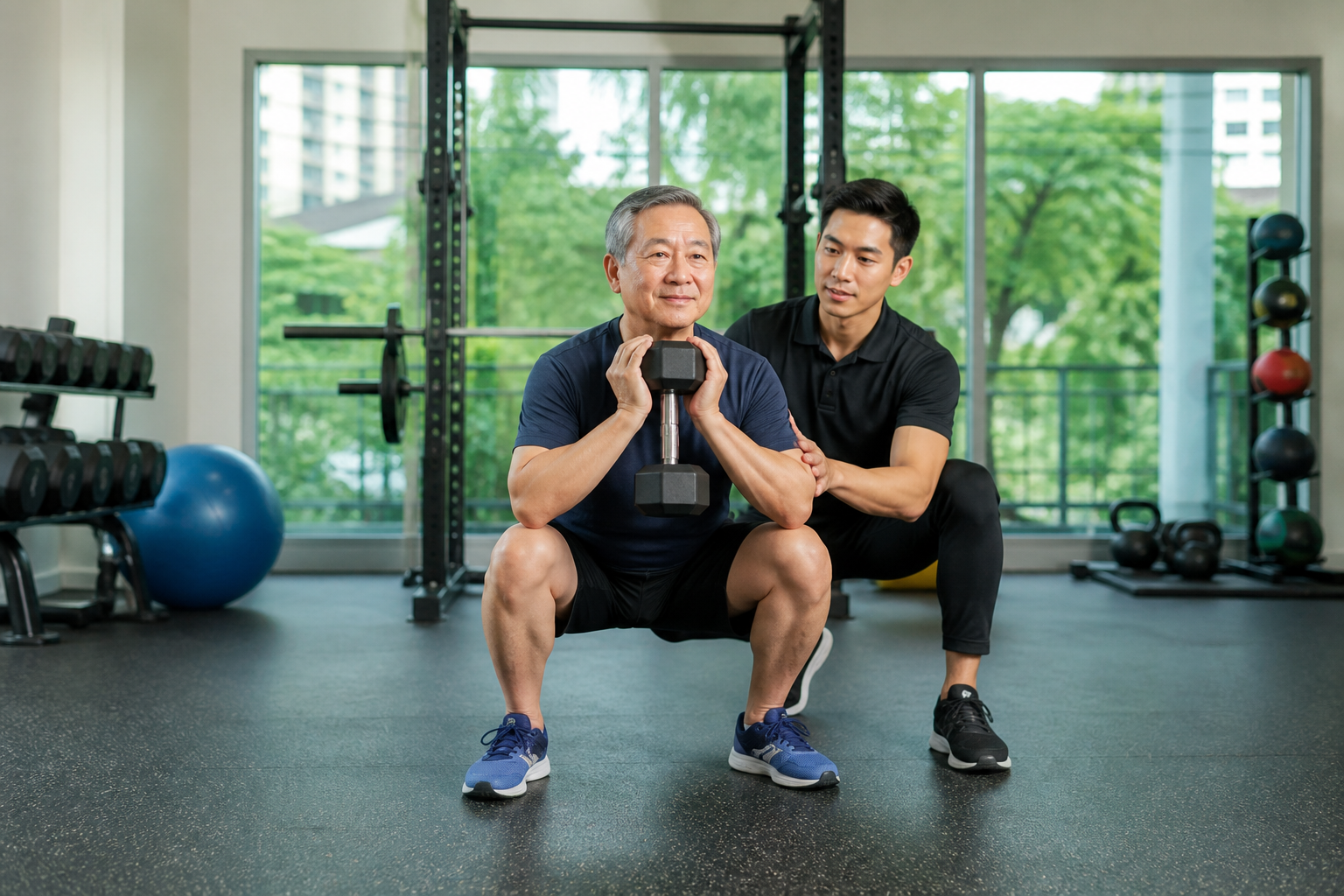
Sarcopenia is a loss of muscle strength and muscle mass that goes beyond normal ageing and starts to limit daily life. In Asian adults it is diagnosed using the Asian Working Group for Sarcopenia (AWGS) 2019 criteria: grip strength below 28 kg in men or 18 kg in women, plus a slow gait speed or chair stand, plus low muscle mass. Progressive resistance training, supported by enough protein, is the best-supported treatment.
This guide goes through the actual numbers, how to screen yourself or a parent at home, and what treatment looks like. For a broader introduction to why muscle loss matters, see our overview of sarcopenia prevention and reversal.
What is the difference between sarcopenia and normal ageing?
Everyone loses some muscle with age. From about the fourth decade, muscle mass and strength drift down, and the loss speeds up after 60 or 70 if people become inactive, eat too little protein or have a long illness. Sarcopenia is the point where that loss is large enough to affect function and safety, such as difficulty standing from a low chair, slow walking or falls.
The word comes from Greek for “poverty of flesh”, but modern definitions put strength and performance first, not just size. Muscle strength predicts outcomes better than muscle mass alone, which is why grip strength sits at the front of the AWGS algorithm.
There are two ways people end up with it. Primary sarcopenia is age-related. Secondary sarcopenia has an added cause such as chronic disease, low food intake, bed rest, or medications. Many older Malaysians have both, for example a person with long-standing diabetes who also eats little protein.
What are the AWGS 2019 criteria?
The AWGS 2019 consensus (Chen et al., Journal of the American Medical Directors Association) updated the 2014 Asian criteria. It created two levels so that doctors and physiotherapists can act earlier, in primary care, without waiting for a scanner.
| Level | What is required |
|---|---|
| Possible sarcopenia | Low muscle strength, or low physical performance |
| Sarcopenia | Low muscle mass, plus low muscle strength or low physical performance |
| Severe sarcopenia | Low muscle mass, low strength and low physical performance together |
The thresholds are as follows.
| Measure | Cut-off for “low” |
|---|---|
| Handgrip strength | Under 28 kg in men, under 18 kg in women |
| Usual gait speed (6 m) | Under 1.0 m/s |
| Five-times chair stand | 12 seconds or longer |
| Short Physical Performance Battery | 9 points or lower |
| Appendicular muscle mass by DXA | Under 7.0 kg/m2 in men, under 5.4 kg/m2 in women |
| Appendicular muscle mass by bioimpedance | Under 7.0 kg/m2 in men, under 5.7 kg/m2 in women |
The practical point is that “possible sarcopenia” can be identified with a hand dynamometer, a stopwatch and a chair. You can read how to run those yourself in our guides to the grip strength test, the gait speed test and the sit-to-stand test.
How do you screen with the SARC-F questionnaire?
SARC-F (Malmstrom and Morley, 2013) is a five-item questionnaire the person answers about themselves. It takes under two minutes and needs no equipment.
| Item | 0 points | 1 point | 2 points |
|---|---|---|---|
| Strength: difficulty lifting and carrying 4.5 kg (10 lb) | None | Some | A lot or unable |
| Assistance in walking across a room | None | Some | A lot, uses aids, or unable |
| Rise from a chair or bed | None | Some | A lot or unable without help |
| Climb a flight of 10 stairs | None | Some | A lot or unable |
| Falls in the past year | None | 1 to 3 falls | 4 or more falls |
A total of 4 or more is a positive screen. SARC-F is specific but not very sensitive. That means a high score is a reliable warning, but a low score does not rule sarcopenia out, so it is best paired with a grip and chair-stand test.
If you or a parent score 4 or more, book an assessment with a physiotherapist or doctor. If you want a quick look at your overall function first, try the functional age tool.
What causes sarcopenia, and what makes it worse?
Several factors add up. Inactivity is the largest modifiable one: muscle that is not loaded is not maintained. Low protein intake, poor appetite, long illness or hospital stays, and bed rest each speed the loss. Chronic conditions such as diabetes, heart failure, COPD, kidney disease and cancer contribute, as do some medicines and low vitamin D. Hormonal change plays a part too, including the fall in oestrogen at menopause and in testosterone with age.
The rate of loss is not fixed. Two weeks of bed rest can cost a measurable amount of leg muscle in an older adult, and recovery takes longer than the loss. That is why getting out of bed early after illness or surgery, and rebuilding with exercise afterwards, makes a difference. See exercise after surgery or a joint replacement for the rehabilitation side.
Obesity can hide sarcopenia, because a person can carry a lot of fat and still have weak muscle. This is called sarcopenic obesity and it is covered separately in our article on sarcopenic obesity. It is also relevant for people losing weight quickly on diet or medicines, who should keep lifting to protect strength.
What do Malaysian studies show?
Malaysian data are growing but patchy, and the numbers vary with the definition used.
- In the Malaysian Elders Longitudinal Research (MELoR) cohort of 774 adults aged 55 and above (mean age about 68), 15.4% were classed as having sarcopenia risk by SARC-F of 4 or more at five-year follow-up. The authors suggested gait speed below 0.7 m/s, and grip strength below 22 kg in men and 17 kg in women, as screening cut-offs in that population.
- In the LRGS-TUA cohort of 2,180 community-dwelling adults aged 60 and above, applying the AWGS 2019 grip cut-offs flagged low grip in 46.2% of men and 48.7% of women, versus about 20% when the lowest-quintile of the local sample was used instead. Mean peak grip was 30.9 kg in men and 19.7 kg in women at ages 60 to 64.
- Reviews put sarcopenia prevalence in Malaysia anywhere from roughly 4% to 28%, depending on the setting and definition.
These numbers tell us two things. The AWGS thresholds appear to label many healthy Malaysian older adults as “low”, especially women, so a single low grip reading is a reason to look further, not a diagnosis. And comparing studies is difficult because the tools differ. For more on what is and is not known locally, see our article on Malaysian fitness norms by age.
What does the evidence say about treatment?
Exercise is the first-line treatment in every major guideline, including AWGS 2019. There is no approved drug for sarcopenia.
Resistance training has the strongest evidence. A Cochrane review of 121 trials in older adults (Liu and Latham) found that progressive resistance training improves strength and some measures of physical function. Meta-analyses restricted to people with sarcopenia (for example Yoshimura et al. 2017) report that exercise improves muscle strength and physical performance, with resistance training more effective than aerobic exercise for building muscle mass. Nutrition on its own gave smaller benefits; combining protein or amino-acid supplementation with exercise produced the best results in some analyses, though results are mixed.
Doses used in the trials vary widely. A typical effective programme looked like this:
- Train 2 to 3 days a week on non-consecutive days.
- Use 6 to 8 exercises covering legs, hips, back, chest and arms.
- Do 2 to 3 sets of 8 to 12 repetitions, at a load that feels like 7 to 8 out of 10 effort.
- Increase the load by about 5 percent when the top of the range feels easy for two sessions in a row.
- Continue for at least 12 weeks before judging progress; many trials ran 12 to 24 weeks.
Aerobic work and balance training add value for heart health and falls, but they should not replace the lifting. Our guide to progressive overload for older adults explains how to progress safely, and sets, reps and rest for older adults gives week-by-week numbers.
How should protein fit in?
Protein supplies the raw material, and older muscle responds less to small doses than younger muscle. Many expert groups suggest roughly 1.0 to 1.2 g of protein per kg of body weight per day for healthy older adults, with more for those who are ill or recovering. For a 65 kg person that is about 65 to 78 g a day.
A typical Malaysian day can fall short. Nasi lemak or roti canai at breakfast, white rice with a small piece of fish at lunch, and most of the protein arriving at dinner is a common pattern. Moving some protein earlier (an egg or two, tempeh, yoghurt, fish or chicken at breakfast and lunch) is a simple fix. Use the protein calculator to get your own range, and read how much protein after 50 for food examples. If you have kidney disease, agree a protein target with your doctor first.
When should you see a professional?
Get assessed if any of these apply:
- A positive SARC-F (4 or more), or two or more falls in a year.
- Grip below 28 kg (men) or 18 kg (women), or a five-times chair stand of 12 seconds or longer.
- Unplanned weight loss, loss of appetite or a recent hospital stay.
- Existing heart, lung, kidney or joint conditions, or osteoporosis, before you start heavy lifting.
A physiotherapist can run the full AWGS battery, rule out other causes of weakness, and set up a progressive programme. Muscle weakness can also point to thyroid problems, vitamin D deficiency, medication effects or neurological conditions, which is why a medical review matters for a sudden change.
Related reading: how to prevent and reverse sarcopenia.
Key takeaways
- AWGS 2019 sets low grip at under 28 kg (men) and 18 kg (women), gait speed under 1.0 m/s, and a five-times chair stand of 12 seconds or more.
- SARC-F of 4 or more is a positive screen, but it misses some cases, so test grip and chair stands as well.
- Malaysian research suggests the Asian cut-offs flag many people, so interpret one low result with care.
- Resistance training two to three times a week, with enough protein, is the best-supported treatment.
This article is general education and does not replace a clinical assessment.