What MOH Malaysia's T2DM guideline and the ADA Standards say about resistance training, with a practical 3-day plan, safety rules and Malaysian food tips.
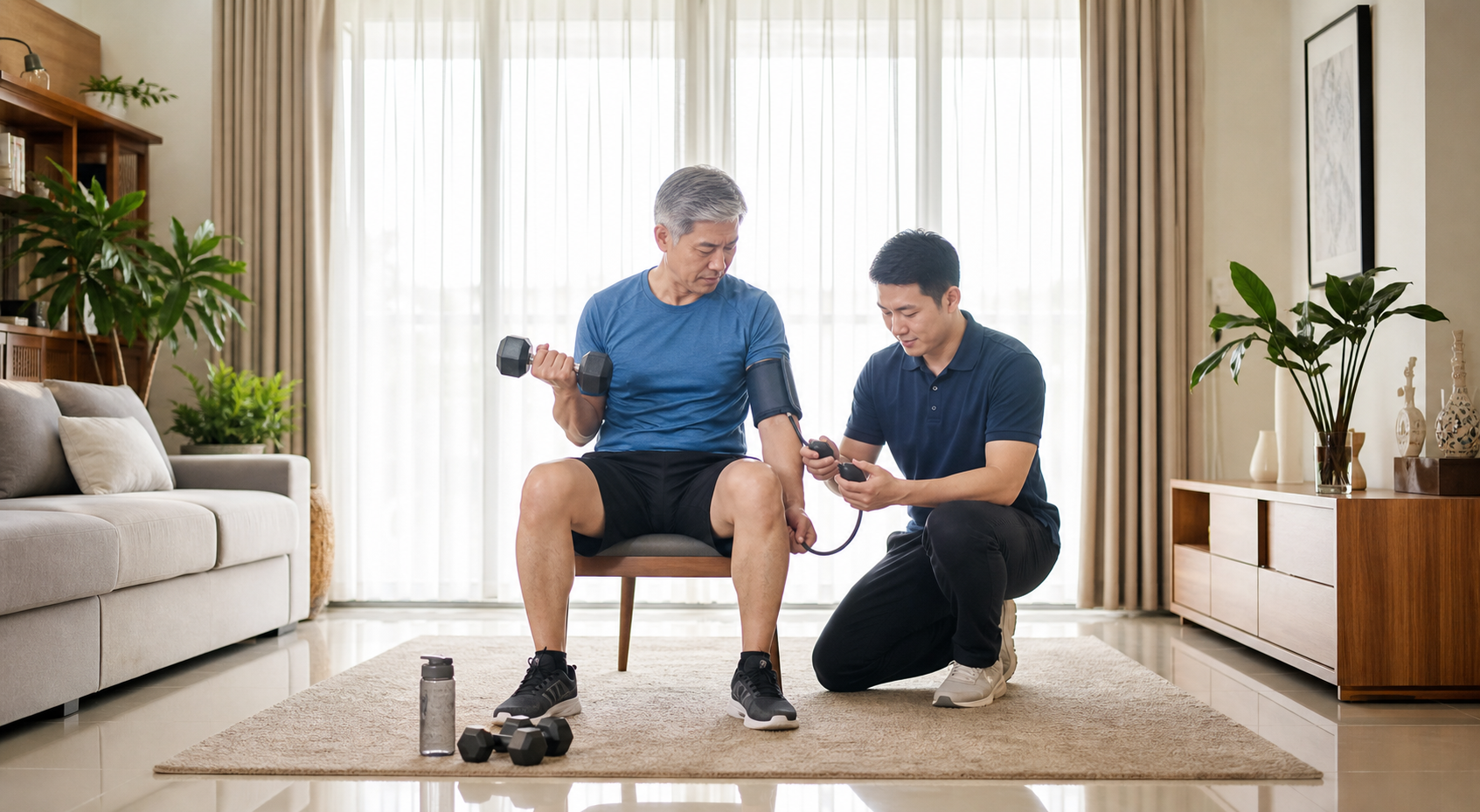
Resistance training is a core part of type 2 diabetes care. The ADA Standards of Care recommend 2 to 3 sessions a week on non-consecutive days alongside at least 150 minutes of aerobic activity, and the Malaysian MOH guideline (6th edition, 2020) supports regular moderate-intensity exercise of at least 150 minutes a week. Lifting improves muscle, which is the main tissue that takes up glucose, and combining it with aerobic work gives the best HbA1c effect in trials.
This article explains what the guidelines say, how to start safely, and how to fit training around Malaysian food, medicines and weather. It builds on our general guide to exercise for type 2 diabetes. Medication safety is covered in exercising on common medications.
How big is the problem in Malaysia?
The National Health and Morbidity Survey 2019 estimated that 18.3 percent of Malaysian adults aged 18 and above, about 3.6 million people, had diabetes, and 49 percent of cases were undiagnosed. Prevalence was 41.5 percent among those aged 60 and above, and was higher in people who were inactive (22.5 percent) and obese (27.1 percent). Physical inactivity affected 24.6 percent of adults in the same survey.
With so many people affected and so many undiagnosed, exercise is not an optional extra. It is one of the few treatments that improves blood sugar, blood pressure, lipids, mood and muscle together. See our overview of exercise and metabolic syndrome and HbA1c explained.
What do the Malaysian guidelines say?
The MOH Clinical Practice Guidelines on the Management of Type 2 Diabetes Mellitus (6th Edition, 2020) place lifestyle modification, including diet, weight management and physical activity, at every stage of treatment. Its exercise advice is to encourage moderate-intensity exercise for at least 150 minutes per week, or at least 75 minutes a week of vigorous aerobic activity.
For resistance training details, Malaysian diabetes education material that follows current guidance, such as the Malaysian Diabetes Educators Society manual, suggests resistance exercise at least 2 to 3 days a week with 2 to 4 sets of 8 to 12 repetitions in addition to aerobic exercise. The exact wording of the resistance-training advice should be checked in the CPG itself, so read the exercise chapter of the guideline or ask your clinic’s educator for the version they follow.
What do the ADA Standards say?
The ADA Standards of Care in Diabetes 2024 (Section 5) recommend that:
- Most adults with type 2 diabetes do at least 150 minutes a week of moderate to vigorous aerobic activity, spread over at least 3 days, with no more than 2 consecutive days without activity.
- Adults do 2 to 3 sessions a week of resistance exercise on non-consecutive days.
- Prolonged sitting is broken up regularly.
The 2016 ADA and ACSM position statement (Colberg et al.) adds that hypoglycaemia during exercise, or for up to 12 hours after, is the main risk for people taking insulin or sulfonylureas. Newer ADA editions (2025 and 2026) continue to include physical activity recommendations, so check the current version for any changes.
Does resistance training lower HbA1c?
The best known randomised trial is HART-D (Church et al. 2010, JAMA) in 262 adults with type 2 diabetes, mean age 55.8 years and baseline HbA1c 7.7 percent.
| Group | Programme | HbA1c change vs control |
|---|---|---|
| Control | No exercise | Reference |
| Resistance alone | 3 days a week | Not statistically significant |
| Aerobic alone | 12 kcal/kg per week | Not statistically significant |
| Combined | Aerobic plus resistance twice a week | -0.34 percentage points (95% CI -0.64 to -0.03) |
Some points to keep in perspective. A drop of 0.34 points is modest, but comparable in size to some medicines and it comes with benefits for muscle and fitness. The single-mode groups did not reach statistical significance against the control group in that trial, so this does not mean lifting does nothing, only that the combined programme worked best there. Adherence, diet and medicines also shape results. Resistance training has other advantages for people with diabetes, such as preserving muscle, improving strength and reducing the risk of sarcopenia. See sarcopenia diagnosis and grip strength and longevity.
How do you start resistance training safely with diabetes?
Before you begin:
- Talk to your doctor if you have heart disease, high blood pressure that is not controlled, kidney disease, eye disease (retinopathy), nerve damage or foot ulcers. Our guide on when to get medical clearance before exercise lists the triggers.
- Check your glucose before training if you take insulin or a sulfonylurea.
- Wear proper closed shoes, and check your feet daily for blisters or cuts.
- Carry fast-acting carbohydrate, such as glucose tablets or juice.
Basic session structure:
- Warm up for 5 to 8 minutes with walking and mobility.
- Do 6 to 8 exercises covering legs, hips, back, chest, shoulders and arms.
- Perform 2 to 3 sets of 8 to 12 repetitions at a hard but controlled effort. About 7 to 8 out of 10 is a good starting guide.
- Rest 60 to 90 seconds between sets.
- Breathe steadily and avoid holding your breath, especially if you have high blood pressure or eye disease.
- Cool down and drink water.
What does a simple 3-day week look like?
| Day | Session | Time |
|---|---|---|
| Monday | Full-body strength: squat to chair, hip hinge, row, incline push-up, step-up, farmer’s carry | 35 to 45 min |
| Tuesday | Brisk walk or cycling at a pace where you can talk | 30 to 40 min |
| Wednesday | Full-body strength with slightly heavier loads | 35 to 45 min |
| Thursday | Walk, plus 10 minutes of balance work | 30 min |
| Friday | Optional third strength session or a longer walk | 30 to 40 min |
| Weekend | One active outing, such as a park walk or swimming | 45 to 60 min |
This gives about 150 minutes of aerobic activity and two to three strength days. Our beginner longevity workout plan and strength training for beginners over 40 give more variety, and the exercise for chronic conditions hub lists related guides. Increase the load by around 5 percent when all sets feel manageable for two sessions in a row; see progressive overload for older adults.
How long until you see results?
Muscle strength usually rises within 4 to 6 weeks, mostly from better nerve control, and visible or measurable muscle gains take 8 to 12 weeks or more. Glucose changes can appear sooner. A single session improves insulin sensitivity for many hours, which is why a regular schedule matters more than one hard session. HbA1c reflects about three months of glucose, so recheck it at your regular clinic visit and see HbA1c explained for how to read it.
Track more than HbA1c:
| What to track | How often | Why |
|---|---|---|
| Working weights and repetitions | Each session | Shows progressive overload |
| Home glucose readings, if you test | Before and after sessions, regularly | Shows your personal response |
| Waist measurement | Monthly | A guide to central fat; see the waist-to-height tool |
| Sit-to-stand and grip strength | Every 8 to 12 weeks | Shows function; see the sit-to-stand test |
| Blood pressure | As advised | Often falls with regular training; see measuring blood pressure at home |
What if you have joint pain or are overweight?
Many people with type 2 diabetes also carry extra weight and have knee or back pain. Resistance training is still possible and often helps the joints by strengthening supporting muscles. Choose low-impact options such as chair squats, machine leg press, band work and seated rows, and avoid movements that sharpen pain. Aim for pain at or below 3 out of 10 during exercise that settles within an hour. Our guides on knee pain and keeping active and exercise for chronic back pain cover common problems.
Weight loss is not required for resistance training to help. Even if the scale barely moves, muscle can rise while fat falls, so measure waist and strength as well. See why the scale lies after 40.
How do you manage low blood sugar risk?
If you take insulin or a sulfonylurea such as gliclazide, glimepiride or glibenclamide, the risk of a low continues for hours. Metformin alone and most newer medicines rarely cause lows.
- Check glucose before and after, and at bedtime on training days.
- Carry 15 g of fast carbohydrate. If you feel shaky, sweaty or confused, stop and treat; recheck after 15 minutes.
- Ask your doctor whether to adjust the dose on training days. Do not do this yourself.
- Avoid training alone if you have had severe lows.
- Very high glucose with ketones is a reason to skip training. Follow your clinic’s advice.
What about Malaysian food, heat and daily life?
Meals. Rice, noodles, roti canai, sweet drinks and kuih push up glucose. Resistance training improves how muscle handles glucose, but it does not cancel a high-sugar day. Choose smaller rice portions, add vegetables and protein, and swap sugared teh tarik or Milo for unsweetened options. See eating for stable blood sugar and Malaysian foods for longevity. A short walk of 10 to 15 minutes after meals also helps with post-meal glucose.
Heat. Train early or late, or indoors with air-conditioning, and drink water often. People on SGLT2 inhibitors or diuretics are more prone to dehydration. See exercising in Malaysia’s heat and humidity and, for hazy days, indoor exercise for hot and hazy days.
Where to train. Many Klang Valley condominiums and housing estates have free gyms and fitness corners, and public outdoor gyms are common. See free outdoor gyms in the Klang Valley and strength training at home in Malaysia. Bands and a pair of adjustable dumbbells are enough to start.
Clinic support. Government health clinics (klinik kesihatan) offer diabetes education and some run exercise sessions. Ask your educator about local programmes. Our exercise physiologist guide explains when a specialist helps.
When should you stop and seek care?
Stop and seek medical help for chest pain, severe breathlessness, fainting, new vision changes such as flashes or a curtain over vision, a foot wound that is not healing, or a glucose reading that stays low despite treatment. Call 999 for chest pain or collapse.
Key takeaways
- ADA recommends 2 to 3 resistance sessions a week plus 150 minutes of aerobic activity, and the MOH CPG supports at least 150 minutes of moderate exercise a week.
- HART-D found the best HbA1c effect with combined aerobic and resistance training.
- Insulin and sulfonylurea users must plan for low blood sugar up to 12 hours after exercise.
- Train in cooler hours, watch your feet, and build up gradually.