Free weights or machines after 60? Both build strength. Here is how to pick, when to switch, sample sets and reps, and safety tips for Malaysian gyms.
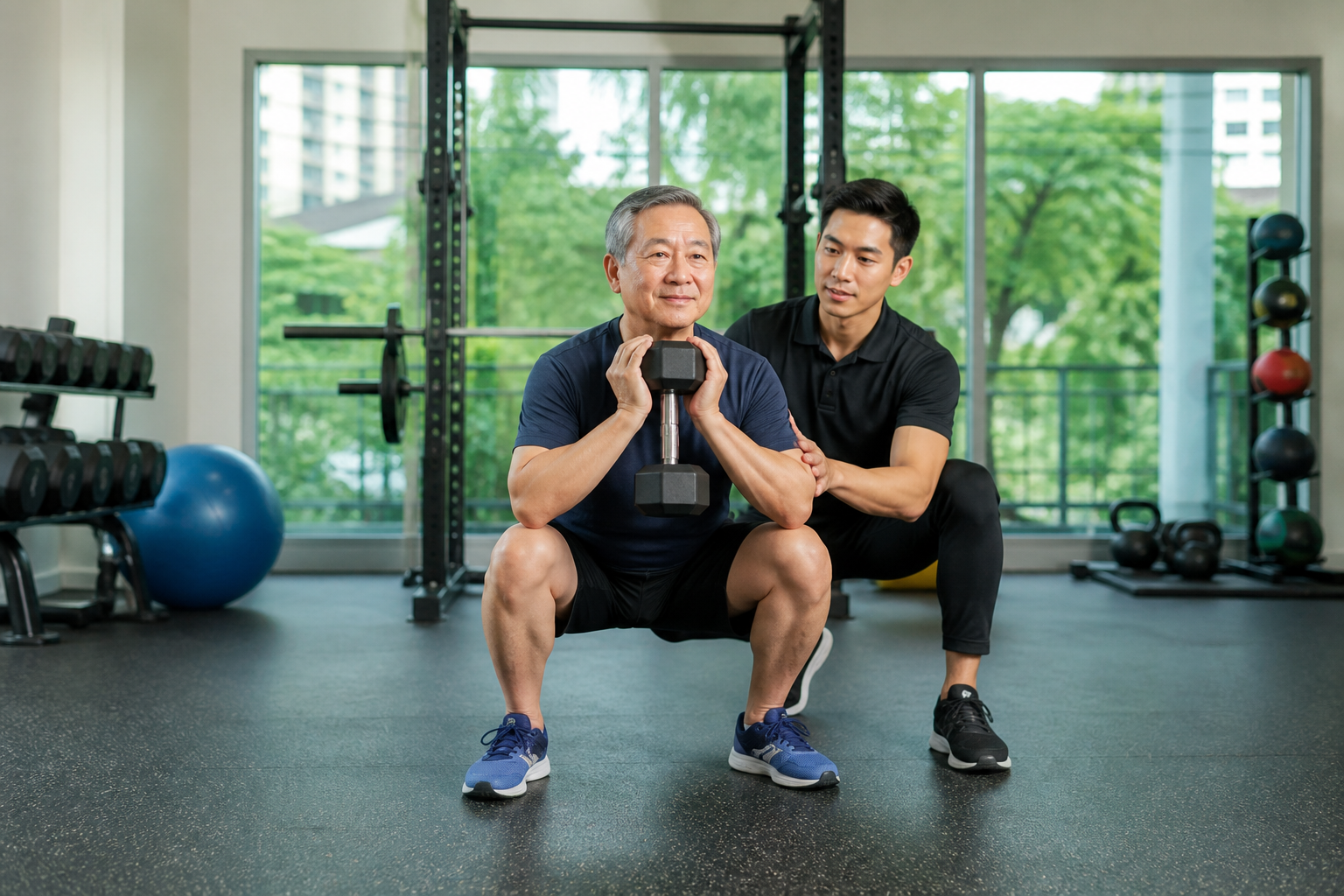
After 60, both free weights and machines build strength, and the research does not show that one is clearly better. Machines suit beginners, people with balance problems and anyone training alone, because they guide the movement. Free weights suit people who want to train real-life movements such as standing up, carrying and reaching, and who have learned the technique. Most older adults do best with a mix.
The bigger decision is whether you train at all. WHO guidelines recommend muscle-strengthening on at least two days a week for adults 65 and over, using all major muscle groups.
What does the research say about free weights vs machines?
A 2023 meta-analysis of 13 studies and 1,016 adults aged 18 to 60 compared the two. It did not include older adults, so the older-adult evidence below is thinner. It found no significant difference in dynamic strength, isometric strength, jump performance or muscle growth. The main finding was specificity: people trained with free weights improved more on free-weight tests, and machine-trained people tended to improve more on machine tests.
A 6-month trial in 32 fit adults aged 60 to 86 found that both free-weight and machine training improved strength. Free weights gave larger gains in leg and triceps strength, but overall the results did not show free weights to be superior.
In practice, pick the tool you will use consistently and can perform with good form. The benefit comes from lifting hard enough, often enough, and progressing over time. Even in people in their late 80s and 90s, progressive resistance training has produced large strength gains, as in the classic study by Fiatarone and colleagues in nursing home residents.
When are machines the better choice?
- You are a beginner. The seat, handles and range of motion are set for you. You can focus on effort rather than balance.
- You have balance problems or dizziness. Seated leg press, chest press and seated row remove the fall risk.
- You train alone. A machine will not drop on your foot, and a pin-loaded stack is easy to adjust by small steps.
- You are returning from injury or surgery. A physiotherapist can pick machines that load the area gradually.
- You need to isolate a weak muscle. A leg extension or hamstring curl targets one group, which can be useful in knee rehabilitation under guidance.
The limits: machines are built around an average body. If the seat does not fit, you may sit awkwardly or lock a joint, so adjust the settings before you load. They also do little for standing balance.
When do free weights make more sense?
- You want carry-over to daily life. Standing up from a low seat, picking something off the floor or carrying shopping all involve balance and coordination. Squats to a chair, deadlifts from a raised height and carries train these patterns.
- You have little access to a gym. Dumbbells and bands are cheap, and our guides to building a home gym in Malaysia and strength training at home show the options.
- You are strong enough that machines cap out. Many strong beginners outgrow the lighter stacks on leg machines.
- You want to build power. Faster lifting such as sit-to-stand with a quick rise, or dumbbell push-presses, is easier with free weights. See power vs strength after 60.
The limits: free weights need technique. Rushing, lifting too heavy or holding your breath raises the risk of strain, and anyone with poor balance should avoid holding weights in unstable positions.
What does a balanced programme look like?
A sample two-day plan for a healthy adult over 60 who has been cleared to exercise. Aim for 2 sets of 8 to 12 repetitions to start, working up to 3 sets over several weeks. Rest 1 to 2 minutes between sets.
| Movement | Machine option | Free-weight option |
|---|---|---|
| Legs, push | Seated leg press | Chair squat holding a dumbbell at the chest |
| Hips and back of the leg | Seated hamstring curl | Romanian deadlift with light dumbbells, or hip hinge to a bench |
| Pull | Seated row or lat pulldown | One-arm dumbbell row with a hand on a bench |
| Push | Chest press machine | Incline push-up on a counter, or dumbbell press |
| Shoulders | Shoulder press machine | Seated dumbbell press, light |
| Trunk | Cable pallof press | Suitcase carry, 20 to 30 seconds per side |
A reasonable mix is to use machines for the heaviest leg work and free weights for rows, carries and hinges. Add 5 to 10 minutes of balance work, such as tandem stance, on a separate day. Our strength training for beginners over 40 article has a gentler starting plan.
How do I progress safely?
- Choose a load you can lift 10 times with clean form. The last two reps should feel hard.
- Do 2 sets, twice a week, for 2 to 3 weeks.
- When you can complete 12 reps on all sets with good form, raise the weight by the smallest step available. The ACSM progression guidance suggests increases of about 2 to 10 percent once you can beat the target reps by one or two.
- If form slips, drop back one step. Progress is not a straight line, particularly in hot weeks or after illness.
- Move one exercise at a time from machine to free weight if you want to, and keep the load light for the first two sessions.
Breathe out on the effort and never hold your breath. Move slowly, about 2 seconds up and 3 seconds down.
Malaysian gym tips
Many Klang Valley gyms are busiest in the evening. If you are new, go mid-morning or early afternoon when staff have more time. Ask for a floor induction rather than a printed card. Our guide to gyms for seniors in the Klang Valley covers what to look for, and free outdoor gyms offer light body-weight options in public parks. The same safety rules apply there. Use equipment in the morning or evening to avoid the worst heat, drink water between sets, and wipe the equipment down.
If you are building your plan for a parent, the ageing parents page and strength training hub give the basics. To see how you compare, try the strength standards tool.
Who should check with a doctor first?
Speak to your doctor before starting heavy resistance work if you have heart disease, uncontrolled high blood pressure, recent surgery, a hernia, unstable joints, severe osteoporosis, or retinal problems that have been flagged by an eye doctor. Stop and seek help for chest pain, dizziness, faintness, a sharp joint pain or sudden shortness of breath. Mild muscle soreness for up to two days is normal when you start. Lingering joint pain or swelling is not.
Key takeaways
- Free weights and machines build similar strength and muscle in older adults. Use the one you can do with good form and will keep doing.
- Machines suit beginners, balance problems and training alone. Free weights suit daily-life movements, home training and power.
- Most people do best with a mix, and 2 sets of 8 to 12 reps, twice a week, is a sound starting point.
- Increase load only when all sets are comfortable, and use the smallest step available.
- Check with a doctor first if you have heart disease, uncontrolled blood pressure, recent surgery or severe osteoporosis.