What exercise is safe with osteoporosis, why loaded spinal flexion is avoided, and what ESSA and Malaysian guidelines recommend.
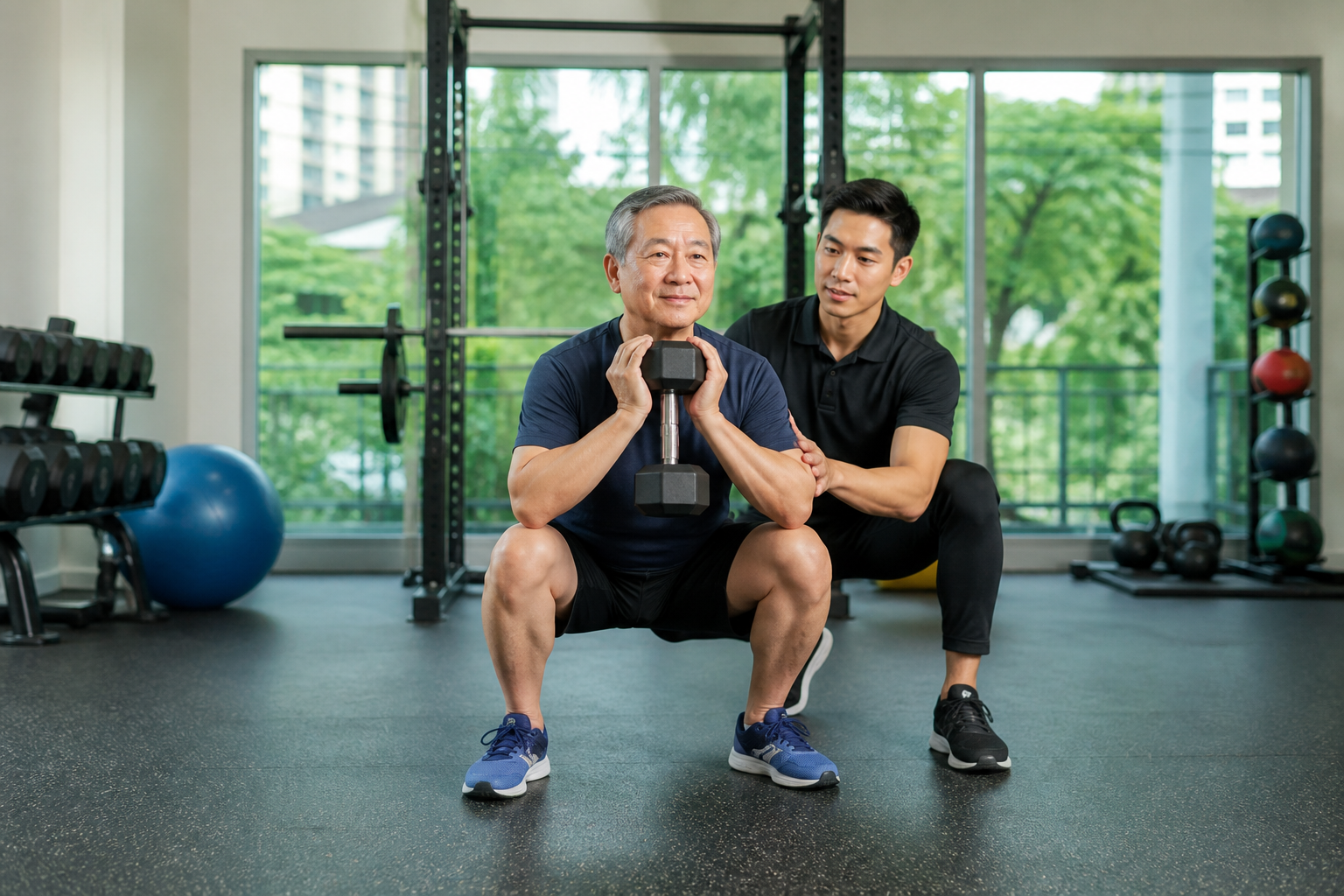
With osteoporosis, most people should lift progressively, balance and walk, and avoid loaded or repeated forward bending of the spine and forceful twisting. Exercise guidance from Exercise and Sports Science Australia (ESSA) and the Too Fit To Fracture consensus supports heavy-enough resistance training and balance work, and Malaysian guidelines recommend weight-bearing activity and fall prevention.
This page is about safety and technique. For why lifting builds bone and a weekly plan, read bone density and osteoporosis, and for the fall side, see hip fracture prevention.
What does the guidance say?
Three sources shape current practice.
ESSA position statement (Beck et al. 2017). Written by Australian exercise scientists, it states that bone responds to impact activities and high-intensity progressive resistance training, and that optimising muscle strength, balance and mobility lowers falls and therefore fracture risk. It covers people with osteoporosis and common comorbidities, and recommends individual prescription for those at very high fracture risk.
Too Fit To Fracture (Giangregorio et al. 2015). A Canadian Delphi consensus. The panel strongly recommended a multicomponent programme including resistance and balance training, and advised that older adults with osteoporosis or vertebral fracture should not do aerobic training to the exclusion of resistance and balance training. It also advises caution with spinal flexion and twisting movements.
Malaysian Clinical Practice Guidelines. The Malaysian guidance (2015 clinical guidance and the 2022 summary) recommends regular weight-bearing exercise, such as brisk walking and line dancing, to maximise peak bone mass, reduce age-related bone loss and maintain muscle strength and balance (Grade C evidence in the 2015 guidance). The 2022 summary adds adequate calcium (1,200 mg a day), vitamin D sufficiency (25(OH)D above 30 ng/mL), regular exercise and fall prevention as non-drug measures. Exercise sits alongside, not instead of, bone medicines where they are needed.
What is safe?
| Type of loading | Examples | Why it helps |
|---|---|---|
| Progressive resistance training | Leg press, sit-to-stand, hip hinge, row, chest press, farmer’s carry | Builds strength, and heavy loads stimulate bone |
| Weight-bearing activity | Brisk walking, stair climbing, line dancing, tai chi | Gentle skeletal load, balance and mobility |
| Balance training | Tandem stance, single-leg stand, heel-to-toe walk | Lowers fall risk |
| Back extension work | Bird dog, prone lifts, wall angels, seated rows with an upright spine | Strengthens postural muscles; may help posture |
| Impact, if cleared | Heel drops, small controlled hops | Stimulates bone, but not for everyone |
Evidence for heavy loading is encouraging. In LIFTMOR, 101 postmenopausal women with low bone mass trained twice a week for 8 months with 5 sets of 5 repetitions above 85 percent of one-repetition maximum plus impact. Lumbar spine bone density rose by 2.9 percent in the training group and fell by 1.2 percent in controls, and a follow-up analysis reported that the programme did not cause vertebral fractures. The training was carefully supervised, with technique coaching on lifts like the deadlift and overhead press. Do not try to copy it unsupervised if you have very low bone density.
The Cochrane review (Howe et al. 2011) found that combined exercise programmes gave the best effect on spine density, though effects are modest. See also our guides to progressive overload for older adults and best longevity strength exercises.
What should you avoid or modify?
Movements that compress the front of the vertebrae under load are the main concern, because osteoporotic vertebrae are more likely to fracture in this position.
| Avoid or modify | Why | Safer swap |
|---|---|---|
| Full sit-ups, crunches, bicycle crunches | Repeated spinal flexion under load | Dead bug, bird dog, front plank on knees |
| Toe-touch stretches, bending forward with a rounded back | Loaded flexion | Hip hinge with a flat back, hands on thighs |
| Lifting a heavy object with a rounded back | High compressive load on the front of the spine | Hinge with neutral spine, hold the load close |
| Forceful trunk twisting, golf swings with force, rotation against resistance | Shear and torsion | Controlled rotation without load, anti-rotation holds |
| Rowing machine with a slumped back | Flexion with load | Seated cable row with an upright spine |
| Deep forward folds in yoga or Pilates “roll-down” | Flexion | Standing or supported poses |
| High fall-risk activities when unsteady | A fall is how most fractures happen | Balance-first classes, support nearby |
Most of the guidance on flexion comes from consensus and biomechanical reasoning rather than large trials, so treat it as a sensible precaution. If you have had a vertebral fracture, avoid all loaded flexion and ask for individual advice.
How do you do a safe hip hinge?
The hip hinge replaces bending the back. See how to do a hip hinge for details.
- Stand with your feet hip-width apart and knees soft.
- Place your hands on your thighs or hold a light weight in front.
- Push your hips back as if closing a door with your bottom, keeping your chest tall and spine long.
- Lower until you feel a stretch in the back of your thighs, usually with the torso about 45 degrees.
- Drive the hips forward to stand.
- Do 2 sets of 8 repetitions, then progress the weight gradually.
How should I progress?
- Start with 2 days a week of full-body resistance work, 2 sets of 8 to 12 repetitions at a moderate effort.
- Add a third set and increase loads by about 5 percent every 1 to 2 weeks as form allows.
- Over 8 to 12 weeks, move toward heavier loads in the 5 to 8 repetition range for lower-body lifts if a professional agrees.
- Add balance practice daily for 5 to 10 minutes, and walk on most days.
- Re-assess with the fall risk check and a sit-to-stand test every few months.
If you are new to training, an exercise physiologist or physiotherapist can set loads that fit your bone health. See do you need an exercise physiologist in Malaysia.
What does a safe session look like?
Here is an example of a 40-minute session for someone with osteopenia or osteoporosis and no recent fracture. A professional should adjust it for you.
| Block | Exercise | Dose |
|---|---|---|
| Warm-up | Marching on the spot, shoulder rolls, bodyweight sit-to-stand | 6 minutes |
| Lower body | Leg press or sit-to-stand with a weight vest or dumbbells | 3 sets of 8 |
| Hinge | Hip hinge with a light dumbbell, neutral spine | 3 sets of 8 |
| Pull | Seated row with an upright spine, or band row | 3 sets of 10 |
| Push | Incline push-up or chest press | 2 sets of 10 |
| Back extension | Bird dog or prone lift, small range | 2 sets of 8 each side |
| Balance | Tandem stand, single-leg stand near a wall | 3 holds of 20 to 30 seconds |
| Cool-down | Walking, gentle chest and hip stretches | 5 minutes |
The loads should feel hard by the last two repetitions, with form staying clean. Breathe out on effort and avoid holding your breath. If you start to round your back, reduce the weight.
Which Malaysian activities are suitable?
Several local activities fit the weight-bearing and balance advice when adapted. Line dancing and senamrobik give rhythmic weight-bearing movement and social support; see senamrobik and line dancing for seniors. Tai chi and qigong train balance and have a low injury rate; read tai chi and qigong for older Malaysians. Stair climbing at home or in apartments is a useful weight-bearing exercise, covered in stair climbing for fitness. Silat is excellent for balance, but forceful twisting and kicks should be avoided if you have vertebral fragility.
Avoid slippery wet floors, uneven pavement at night and poorly lit stairs. Heat can make you dizzy, so choose cooler hours or air-conditioned spaces; see exercising in Malaysia’s heat and humidity.
What if you have already had a vertebral fracture?
A vertebral fracture changes the plan. The aims become protecting the spine, strengthening the back and hip extensors, improving posture and preventing falls. Avoid all loaded flexion and twisting, and progress carefully. Early rehabilitation with a physiotherapist is helpful after the acute pain settles, and a doctor will review your bone medicine. Do not start heavy lifting until you have had a proper assessment.
If you have severe kyphosis, balance problems or frailty, start with supported exercise such as seated or wall-supported work and add load slowly. The balance and stability hub and balance exercises to prevent falls are good starting points.
Why does fracture risk matter more than the T-score?
Osteoporosis is defined on a DXA scan as a T-score of -2.5 or lower, but the risk of breaking a bone depends on much more than the number. Age, previous fractures, family history, steroid use, smoking, low body weight and falls all matter, which is why Malaysian guidelines use fracture-risk tools such as FRAX alongside bone density. A person with a T-score of -2.0 and a history of falls can be at higher risk than someone with a T-score of -2.6 who is strong and steady.
This is why exercise advice has two goals. One is to improve bone strength where possible. The other, probably more important in daily life, is to reduce falls by improving strength, balance and reaction. Our guide to reaction time and falls and why balance declines with age explain the second goal.
What myths should you ignore?
- “I should stay still to protect my bones.” Inactivity weakens bone and muscle and increases fall risk. Careful, progressive loading is protective.
- “Weights are dangerous for brittle bones.” Poorly chosen movements are dangerous, such as loaded forward bending. Controlled lifting with neutral posture is recommended by ESSA and by the Too Fit To Fracture panel.
- “Walking alone is enough.” It is valuable but gives only a small bone stimulus and does not build strength much.
- “Calcium tablets are all I need.” Calcium and vitamin D help, but they do not replace exercise or, where indicated, bone medicines.
- “If my scan is normal I can ignore all this.” Bone loss is silent, so build habits early; see exercise in your 50s.
What are the warning signs?
Stop and seek review for:
- Sudden new back pain, especially after lifting, a cough or a minor fall. It may be a vertebral fracture.
- A noticeable loss of height or new rounding of the upper back.
- Pain that wakes you at night or does not ease with rest.
- A fall with a hit to the hip, wrist or back.
- Numbness, leg weakness or loss of bladder or bowel control, which needs emergency care.
Food and medicine
Calcium, vitamin D and protein support bone and muscle. Aim for about 1,200 mg of calcium daily from food and supplements combined (the Malaysian CPG figure), and discuss vitamin D levels with your doctor. See calcium for bone health, vitamin D in Malaysia and how much protein after 50. Bone medicines, such as bisphosphonates, do not prevent you from exercising, and training and medicines work together. Our strength training for longevity hub lists more guides.
Key takeaways
- Heavy-enough progressive resistance training and balance work are recommended; low-effort routines alone are not enough.
- Avoid loaded forward bending and forceful twisting; hinge at the hips instead.
- LIFTMOR shows supervised heavy lifting can improve spine bone density without fractures in selected women.
- Sudden back pain after a minor event needs medical review.