Why lifting matters after menopause: the LIFTMOR bone trial, Cochrane exercise evidence, how HRT fits in, and a safe twice-weekly plan.
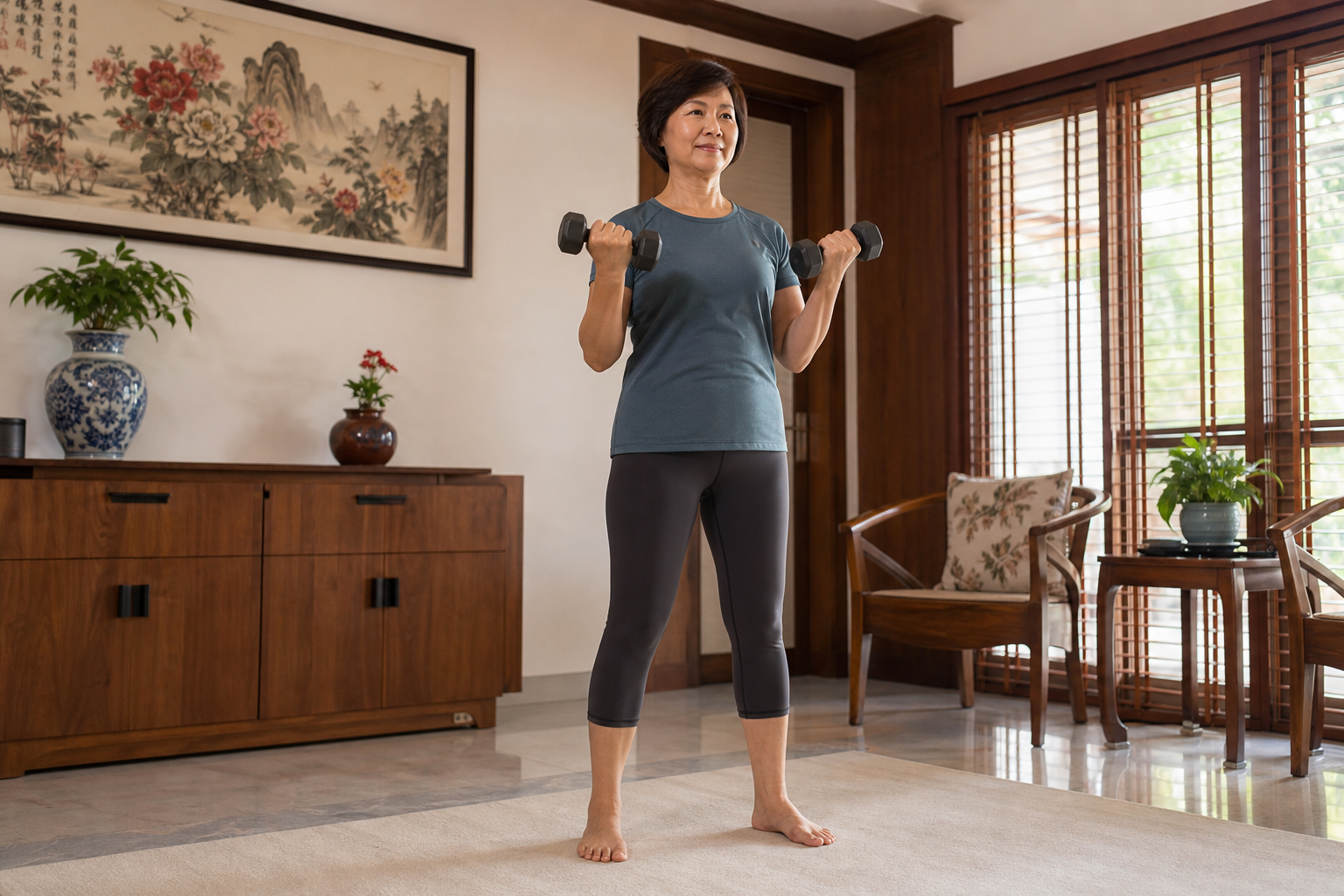
Strength training after menopause protects the two tissues that fall fastest when oestrogen drops: bone and muscle. The best bone trial in this group, LIFTMOR, found that heavy supervised lifting raised spine bone density by 2.9 percent over 8 months while a gentler home programme lost 1.2 percent. Two to three weekly sessions of progressive resistance training are the practical target, with or without hormone therapy.
This article sits alongside our guides on exercise for menopause, perimenopause versus menopause training and strength training for women over 40 and 50. Here the focus is on the evidence for bone and muscle, and where hormone therapy fits.
What happens to bone and muscle at menopause?
Oestrogen helps restrain bone breakdown. When levels fall around the final period, bone is lost faster for several years, which is why osteoporosis is much more common in women than in men. Muscle strength also tends to decline faster with age, particularly if activity falls and protein intake is low.
Some changes are physiological and some are lifestyle. Sleep disruption, hot flushes, joint aches and low mood all reduce the motivation to train. That is part of the reason this stage is a high-value moment to build a routine.
Malaysian guidelines treat bone health seriously. The Malaysian Clinical Practice Guidelines on postmenopausal osteoporosis (2022 summary) recommend adequate calcium (about 1,200 mg a day from diet and supplements combined), vitamin D sufficiency, regular exercise and fall prevention as the basis of non-drug management. Our articles on calcium for bone health and vitamin D in Malaysia give the food and sun details.
What did the LIFTMOR trial find?
LIFTMOR (Lifting Intervention For Training Muscle and Osteoporosis Rehabilitation) is a randomised trial from Australia published in the Journal of Bone and Mineral Research in 2018 (Watson et al.). It enrolled 101 postmenopausal women with low bone mass (T-score below -1.0).
| Feature | Intervention group | Control group |
|---|---|---|
| Programme | High-intensity resistance and impact training | Home-based, low-intensity exercise |
| Frequency | Twice a week, 30 minutes, supervised | At home |
| Resistance load | 5 sets of 5 repetitions at above 85% of one-repetition maximum | Light |
| Length | 8 months | 8 months |
| Lumbar spine bone density | +2.9% | -1.2% |
| Femoral neck bone density | +0.3% | -1.9% |
The training group also improved functional performance such as strength and mobility. No adverse events occurred under supervision, and a follow-up report found the heavy lifting did not cause vertebral fractures.
What it means for you:
- The load was heavy and progressive. Low-effort programmes did not prevent bone loss.
- The sessions were supervised by trained staff, who coached deadlifts, overhead presses, back squats and jumping drops with careful technique. This is not a programme to copy alone from a video.
- The women had no recent fractures and were generally healthy. If you have osteoporosis or a history of fracture, get individual advice.
The Cochrane review of exercise for postmenopausal women (Howe et al. 2011, 43 trials, 4,320 women) found a small but real overall effect of exercise on bone density, with combinations of exercise types such as resistance plus impact most useful for the spine. Together, the evidence says exercise does not make large changes to bone, but it prevents loss, and it improves the muscle and balance that determine whether a fall becomes a fracture.
What does strength training do for muscle after menopause?
The Cochrane review by Liu and Latham found that progressive resistance training improves strength and physical function in adults aged 60 and over, and the principle applies in earlier postmenopausal years. Practically, stronger legs and hips make stairs, getting up from the floor, carrying shopping and walking in uneven places easier. They also lower the risk of falling.
Muscle is also metabolically active tissue. Keeping it supports blood sugar control and healthy weight, which matter because many women notice more abdominal fat after menopause. Our article on why the scale lies after 40 explains why body weight alone is a poor guide.
Where does hormone therapy fit in?
Menopausal hormone therapy (HRT) is a separate decision from exercise. The 2022 NAMS position statement says hormone therapy is the most effective treatment for hot flushes and has been shown to prevent bone loss and fracture. It states that benefits generally outweigh risks for healthy symptomatic women under 60 or within 10 years of menopause, and that starting after 60 needs a careful individual assessment. Lower doses and transdermal routes may reduce clot and stroke risk.
Malaysia has its own menopause guidance, summarised in a 2022 review of the Malaysian CPG from a primary care view, and your doctor will apply it to your history of breast disease, clots, heart disease and migraine.
For training, three points follow:
- You do not need to be on HRT to benefit from lifting, and being on HRT does not replace lifting.
- Exercise helps many menopausal symptoms, including mood and sleep, in some women, but it is not a substitute for medical treatment of severe symptoms.
- If you take HRT or bone medicines such as bisphosphonates, tell your trainer or physiotherapist. It will not stop you from training.
I cannot give a view on whether you should start HRT. That belongs with your doctor.
What does a safe twice-weekly plan look like?
This is a starting plan for a healthy woman without osteoporosis or known heart disease. If you have osteoporosis, see our guide on osteoporosis-safe loading first.
- Warm up for 5 to 8 minutes: walking, arm circles, bodyweight squats. See the warm-up routine after 40.
- Squat to a chair or goblet squat, 3 sets of 8 to 10.
- Hip hinge or Romanian deadlift with dumbbells, 3 sets of 8 to 10. Technique guide: how to do a hip hinge.
- Row with a band or cable, 3 sets of 10 to 12.
- Push-up on an incline or wall, 2 to 3 sets of 8 to 12.
- Step-ups, 2 sets of 8 each leg.
- Farmer’s carry, 3 walks of 20 to 30 metres. See how to do a farmer’s carry.
- Optional: heel drops or small controlled hops, if cleared by your physiotherapist for bone loading.
Progression: use a weight that leaves 2 repetitions in reserve. When you finish all sets with good form on two sessions in a row, add about 5 percent or the next small weight step. Over 12 weeks, many women move from body weight or 2 kg dumbbells to 8 to 12 kg for lower-body lifts. Heavier loading, as in LIFTMOR, should be built up gradually and supervised.
Add 150 minutes of moderate activity such as brisk walking across the week, and some balance work. The fall risk check is a quick test of where you stand. For a bigger picture, see our exercise for hormonal change hub.
How do you know it is working?
Bone changes take months and only show on a scan, so track what you can see sooner. Retest every 8 to 12 weeks:
| Test | What improvement looks like |
|---|---|
| Sit-to-stand (30 seconds or five repetitions) | More repetitions, or a faster five-time stand |
| Grip strength | A few kilograms higher over 12 weeks |
| Working weight on squat and row | Heavier loads at the same effort |
| Stairs and getting off the floor | Easier, with less hand support |
Guides to the sit-to-stand test and grip strength test explain the methods. Sleep, mood and energy often improve alongside strength. If you stall for more than four weeks, review sleep, protein and whether the load is truly challenging.
Protein, calcium and Malaysian food
Protein supports the training. Aim for protein at each meal; eggs, fish, tofu, tempeh, lean chicken and dhal are all suitable. Rice-heavy plates often leave protein low, so adding a palm-sized portion helps. See protein for women over 40 and the protein calculator.
For bone, small fish eaten with bones such as ikan bilis, calcium-set tofu, leafy greens and dairy or fortified soy milk contribute calcium, and some sun exposure helps vitamin D. Avoid smoking and limit alcohol.
When should you see a doctor first?
Check with your doctor before heavy lifting if you have:
- A previous fracture, a known T-score of -2.5 or lower, or severe back pain.
- Heart disease, uncontrolled blood pressure, or chest pain with effort.
- Vaginal bleeding after menopause.
- Pelvic floor symptoms such as leakage or heaviness. See pelvic floor and core as you age.
A DXA scan is the standard way to measure bone density. Our note on DEXA scans in Malaysia covers cost and access.
Key takeaways
- LIFTMOR showed that heavy, supervised resistance and impact training can raise spine bone density in postmenopausal women with low bone mass.
- Cochrane evidence shows exercise has a small but real effect on bone density, and training improves muscle and function.
- HRT is a separate medical decision with its own benefits and risks; exercise works with or without it.
- Start with two sessions a week, progress slowly, and get supervision for heavy loading.