Stiff hips make standing, walking and floor sitting harder. Six gentle hip mobility exercises with holds and reps, plus safety tips.
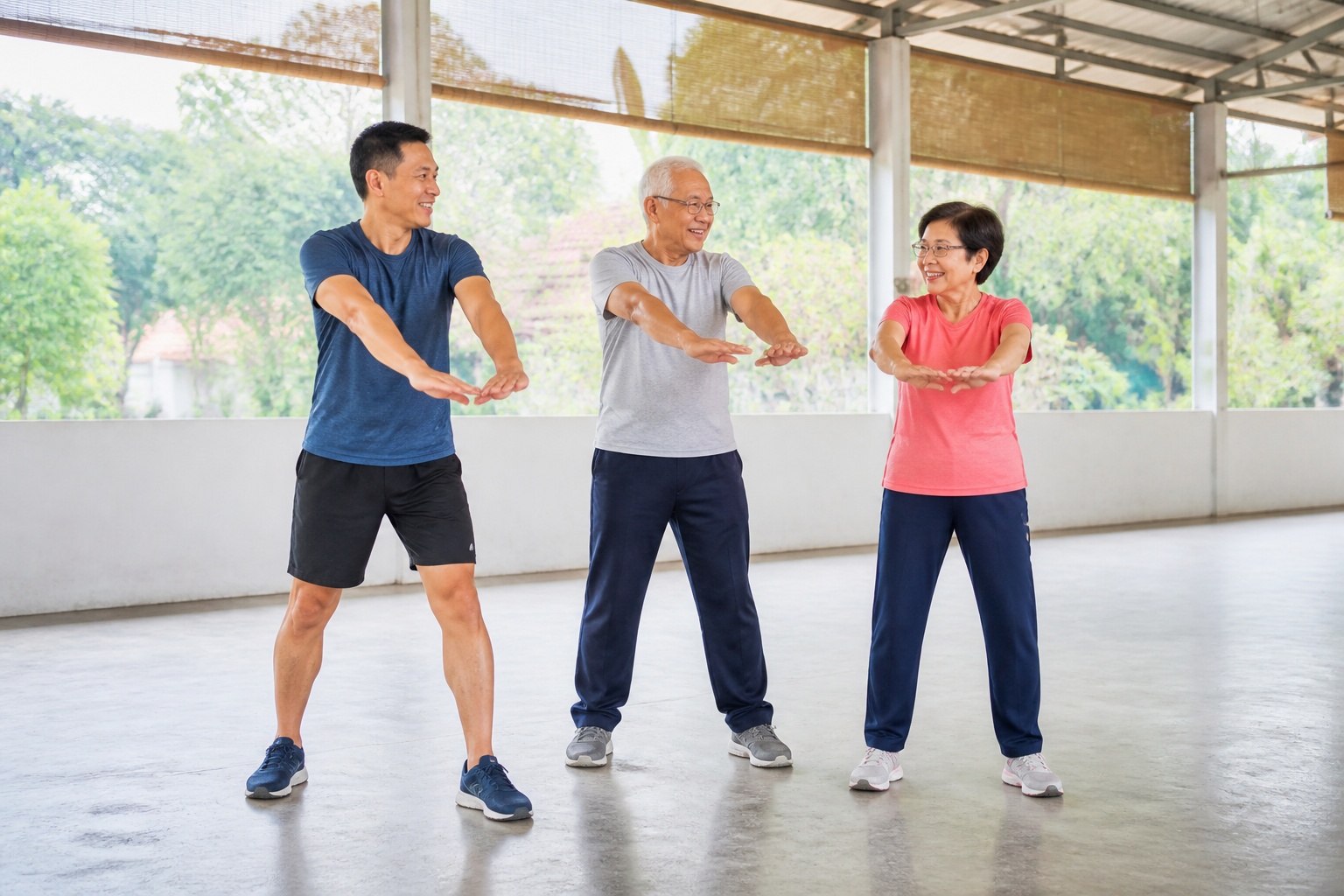
You can restore much of your hip mobility with five to ten minutes a day of gentle hip movements, combined with strengthening for the glutes and legs. Stiff hips make it harder to stand up, walk with a full stride, put on socks or sit on the floor, and they push extra work onto your lower back and knees. Keep every movement comfortable and pain-free.
Why hips stiffen
Several things contribute:
- Sitting. Hours at a desk or in a car keep the hip flexors short and the glutes quiet.
- Less varied movement. Fewer squats, floor sits and long strides narrow the range you use.
- Muscle loss. Weak hip muscles control the joint poorly, so the body avoids the range.
- Osteoarthritis. Cartilage wear can restrict movement, especially rotation. Exercise is still recommended, as the 2014 Cochrane review of exercise for hip osteoarthritis found a small reduction in pain, though little clear benefit for self-reported function.
In Malaysia there is a further factor: many daily habits involve the hips, such as sitting cross-legged at family gatherings, using squat toilets and sitting on the floor for prayer or meals. Losing hip range makes these harder, and difficulty getting down and up from the floor is a marker of declining function. See how to get up from the floor.
Why it matters
When the hips move well, you can squat, hinge and step without the back or knees doing the work. That supports safe lifting through the hip hinge, a longer stride and steadier balance. Walking speed and chair-rise ability, both partly dependent on hip function, are linked with independence. See functional movement for longevity.
Six gentle hip exercises
Do these once a day, or at least four days a week. Hold a counter or chair for support where noted. Stay within comfort and breathe normally.
| Exercise | How | Dose |
|---|---|---|
| Hip circles | Stand holding a counter. Lift one knee and draw slow circles outward, then reverse | 6 to 8 each way, each leg |
| Leg swings | Hold support. Swing one leg forward and back with a relaxed knee, then side to side | 10 each direction, each leg |
| Half-kneeling hip flexor stretch | Kneel on one knee on a cushion, tuck the pelvis under, shift forward gently | 20 to 30 seconds, 2 to 3 times each side |
| Seated figure-four | Sit tall, rest one ankle on the opposite knee, lean forward from the hips | 20 to 30 seconds, 2 times each side |
| Supported squat to chair | Stand in front of a chair, sit back and stand again, feet shoulder-width | 2 sets of 8 to 10 |
| Lying knee rock | Lie on your back, knees bent, let both knees fall slowly to one side then the other | 8 to 10 each way |
For standing or kneeling positions, use a stable surface and rise slowly. Our daily 10-minute mobility routine and morning mobility routine place hip work inside a fuller sequence.
Add strength so the range lasts
Mobility you cannot control is of limited use. Pair the exercises above with:
- Glute bridges, 2 to 3 sets of 10 to 15.
- Step-ups and squats, 2 to 3 sets of 8 to 12.
- Single-leg stands for hip stability, 20 to 30 seconds per leg.
Loading muscles through range, not only stretching, is why strength training is part of any stretching vs mobility plan. See the wider principles in strength training for longevity.
Make it a habit
Link the routine to something you already do: after waking, while the kettle boils, or before your evening walk. Heat and humidity make morning or air-conditioned practice more comfortable. Daily short sessions beat weekly long ones.
Safety and red flags
- Stay in a comfortable range. Mild stretch is fine. Sharp or pinching pain at the front of the hip means ease off.
- After a hip replacement, follow your surgeon’s restrictions. With some approaches, you must avoid bending the hip beyond about 90 degrees and crossing the legs for a period. The seated figure-four and deep squats may be restricted. See exercise after knee or hip replacement.
- See a doctor for hip or groin pain that is severe, constant or wakes you at night, pain after a fall with difficulty bearing weight, fever with a hot swollen joint, or numbness or weakness in the leg.
- If you have osteoporosis, avoid forcing end-range positions, and ask for advice. See osteoporosis-safe loading.
Simple self-checks
- Chair rise. Can you stand from a standard chair without using your hands? See sit-to-stand test.
- Seated figure-four. Can you rest an ankle on the opposite knee without leaning back or straining? Compare the two sides.
- Squat to a chair. Can you sit back and stand up without your back rounding or your knees collapsing inwards?
- Floor transfer. Can you get down to the floor and up again, using a hand or a sturdy chair if needed?
If one side is clearly tighter or more painful, work that side first, and consider a physiotherapy assessment.
Common mistakes
- Forcing end-range stretches until it hurts. Mild tension is enough.
- Bouncing in a stretch, which can provoke the muscle to tighten.
- Stretching without strengthening, so the range does not stick.
- Doing it only once a week. Short daily sessions work better.
- Ignoring the back. Keep your trunk tall and avoid arching to fake hip range.
Key takeaways
- Sitting, reduced movement, weak hip muscles and arthritis all stiffen the hips, and gentle daily movement restores much of the range.
- Do six simple exercises for five to ten minutes a day, holding stretches for 20 to 30 seconds.
- Add glute and leg strengthening so the new range is controlled and lasts.
- Follow your surgeon’s rules after a hip replacement, and see a doctor for severe or night pain.
- Better hip mobility makes floor sitting, walking and standing up easier, and reduces strain on the back and knees.
If you would like a mobility and strength plan for your hips, we run home-visit assessments across KL and Selangor.