Group class, fitness app or personal coach? What research says about sticking with exercise after 40, with Malaysian tips and a simple way to choose.
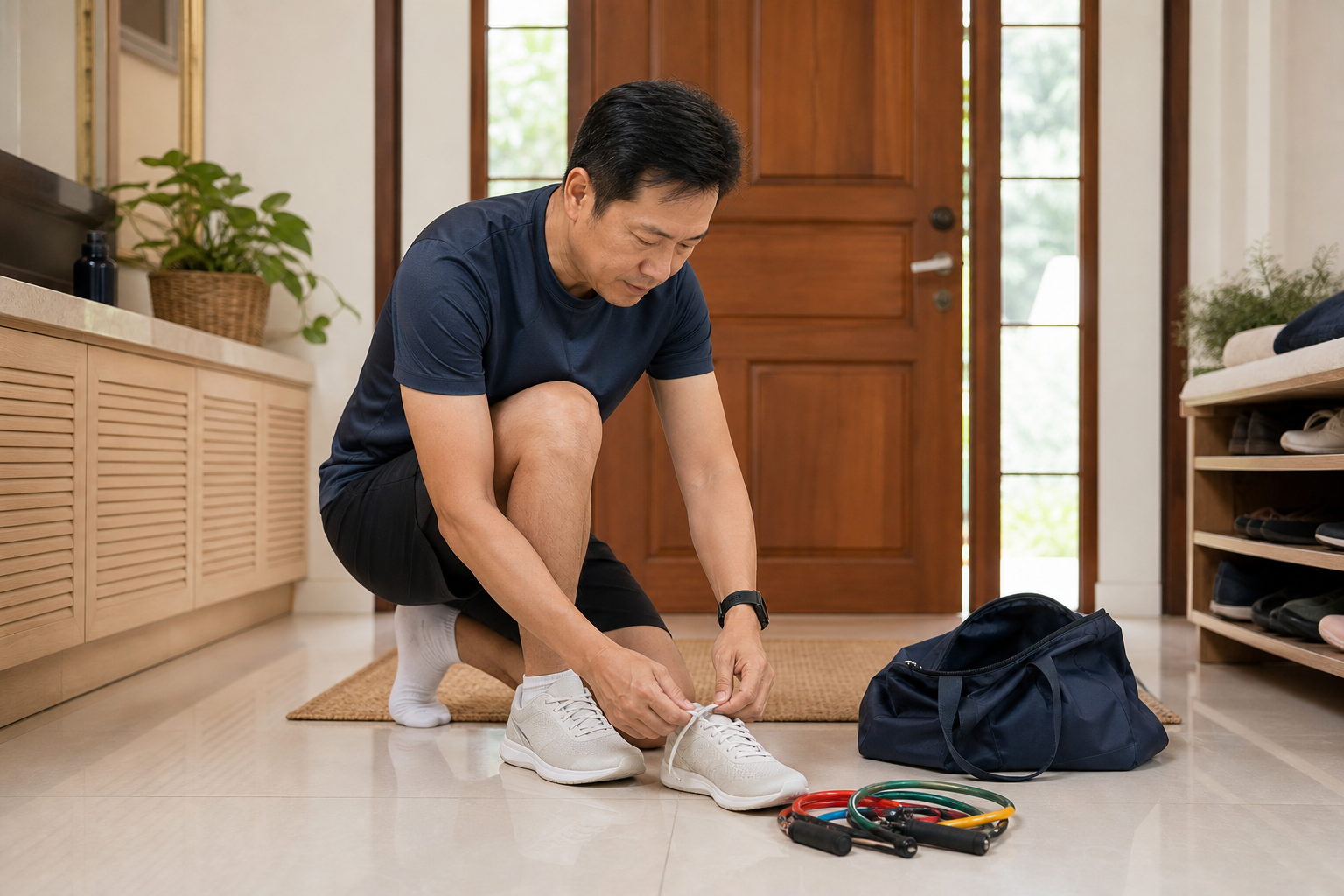
The format that keeps you going is the one that fits your weak point. If you struggle with motivation and loneliness, a group class helps most. If you struggle with time and cost, an app helps most. If you struggle with pain, fear or not knowing what to do, a coach helps most. Research on older adults points to similar ingredients in every format: regular contact, feedback, clear goals and a plan that gets harder gradually.
Starting is often the easy part. What matters is what carries you through the middle weeks and past a bad month.
What does research say about adherence in older adults?
A systematic review by Room and colleagues looked at the interventions used to improve exercise adherence in older people and the behaviour-change techniques behind them. The review reported that activity monitoring with feedback, written instructions and booster sessions may help people keep going. Social support is a sensible addition. None of them belongs to one format: a coach, a class leader or a well-designed app can supply them.
A meta-analysis of 34 trials (2,830 older adults) found that supervised exercise gave larger gains in physical function and well-being than unsupervised exercise, and that attendance was similar in both (about 81%). A review of home-based video exercise programmes in older adults found average attendance of 85% and retention of 91%, with lower attendance when there was no live contact with a coach, and when sessions ran longer than 60 minutes. These were mostly trial settings, so real-life dropout is likely higher.
Unsupervised exercise works when people do it, so the better format is the one that gets you doing it.
How do the three options compare?
| Group class | Fitness app | Personal coach | |
|---|---|---|---|
| Accountability | Social, a regular slot, people notice if you are absent | Notifications, streaks, self-driven | Appointment, personal relationship |
| Feedback on technique | Limited, depends on class size | Little or none, video guides only | High, tailored |
| Individual adjustment | Modifications offered, not tailored | Some progression, not responsive to pain | Full |
| Cost per month | Low to moderate | Low | Moderate to high |
| Flexibility | Fixed times | Any time, any place | Appointment times |
| Best for | Social people, general fitness | Self-starters, travellers, busy people | Pain, injury, beginners, specific goals |
| Main risk | Intensity not matched to you | Lower attendance without live contact | Cost, dependence |
When is a group class the right choice?
Group classes suit people who like company and a fixed schedule. They also help if you live alone, are newly retired, or lose enthusiasm when nobody expects you to turn up.
Look for:
- a class designed for adults over 50 or a mixed class with clear options for different levels;
- an instructor who walks around and corrects technique;
- a class size where the instructor can see everyone, small enough that the instructor can see everyone;
- a mix of strength, balance and gentle cardio rather than only dance or stretching.
Exercise reduced falls in community-dwelling older people by about 21% in the Sherrington meta-analysis, with larger effects from programmes that challenged balance, so a class that includes strength and balance is worth more than one that only moves the arms. NICE guidance also recommends considering group exercise programmes for episodes of low back pain.
Malaysia has many options, from community taman and surau-based groups to RTC and PPR activities, church or temple groups, and morning tai chi and qigong in public parks. Our guides to group and community exercise in Malaysia, community run groups in the Klang Valley and group class vs one-to-one for seniors give more detail.
When does a fitness app make sense?
An app works if you already have the habit, travel often, or cannot attend a fixed class because of shift work or caring duties. It is the cheapest option and the easiest to try.
To get more from an app:
- Pick one with video demonstrations and a plan that progresses, not just random workouts.
- Put your sessions in the calendar as you would an appointment.
- Tell a friend or family member your plan. A weekly message about what you completed adds accountability.
- Review it after four weeks. If you have skipped most sessions, move to a group or a coach rather than trying one app after another.
Apps cannot see your technique or adjust to pain. If you have joint pain, osteoporosis, heart disease or have fallen, get a professional assessment before relying on an app. Our article on online vs in-person coaching discusses the middle ground.
When is a coach worth the cost?
A coach is worth it when getting it wrong would be costly: pain, a recent injury or surgery, a fall, a long gap since you last exercised, a health condition, or a specific goal such as improving your sit-to-stand time.
A coach should:
- ask about your health history and goals;
- measure a baseline, such as 30-second sit-to-stand, grip strength or walking speed, and retest every 6 to 8 weeks or so;
- teach you the programme so that you can eventually train without them;
- adjust loads when you hurt, and refer you to a doctor or physiotherapist when needed.
Costs vary widely. See our guides to the cost of personal training in the Klang Valley and what it costs to get fit in Malaysia. A common approach is to book a short block of sessions for set-up, then move to a class or app with a monthly check-in.
Can I combine them?
Yes, and many people do best this way. A practical mix for an adult over 40 with limited time:
- One coach or physiotherapy session to build a baseline and learn the basics.
- Two group sessions a week for social contact and regular timing.
- One short app or home session for strength on a flexible day.
- Daily walking, ideally with someone.
This meets WHO’s guidance of muscle-strengthening on two or more days a week and 150 to 300 minutes of moderate aerobic activity, with older adults also doing balance and multicomponent activity three or more days a week.
What if motivation drops anyway?
It will, at some point. Heat, haze, festive seasons, school holidays and caring duties all disrupt routines in Malaysia, so plan for it.
- Keep a minimum version, such as 10 minutes of squats and walking, for bad weeks.
- Move indoors on hazy days and check the air quality index first.
- Track something you can see, such as the number of sessions per week or chair stands in 30 seconds. Try the chair stand norms tool.
- Tell someone your plan, so that someone notices when you skip.
For more ideas, read how to build an exercise habit, staying consistent when life gets busy and exercise when unmotivated. Our longevity mindset and habits hub collects them in one place.
Who should check with a doctor first?
Check with a doctor before starting a new programme, whichever format you choose, if you have heart disease, high blood pressure that is not controlled, diabetes on insulin or sulfonylureas, recent surgery, unexplained dizziness or you have not exercised for years. Stop and seek help for chest pain, fainting, severe breathlessness or new, sharp joint pain. Group classes and apps cannot see these warning signs, so listen to your body and do not push to keep up with others.
Key takeaways
- The best format is the one that covers your weak point: company for motivation, an app for flexibility, a coach for safety and technique.
- Goals, feedback, monitoring and social contact are the usual tools for keeping people exercising, whatever the format.
- Apps are cheap, but home programmes with no live contact tend to have lower attendance. Pair one with a person or a group.
- Combining a short coaching block with group sessions and daily walking covers most needs.
- Check with a doctor first if you have heart disease, uncontrolled blood pressure, recent surgery or have fallen.